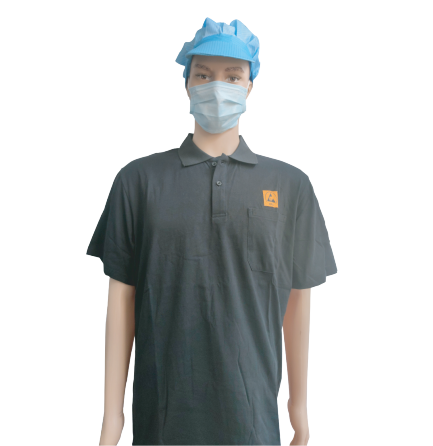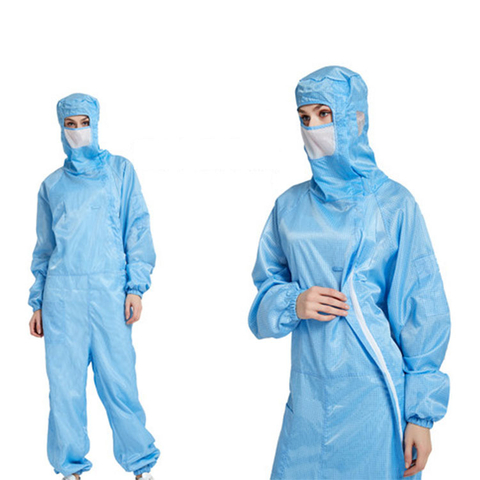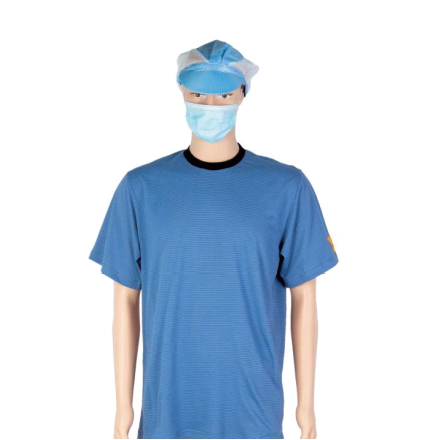
ESD clothing is specifically designed to prevent static charges passing from a person, or their clothing, into the surrounding environment. They are worn whenever static damage is a concern and are common practice in many industries. Some of the most common types of ESD clothing you’ll find are ESD shirts, coveralls and jackets, polo and etc.
We focus on the production and sales of high-level anti-static clothing. Our products are of high quality, durable and have a particularly stable anti-static index. In addition, we have a variety of styles for you to choose from, and we have the ability to provide you with customized services.The cubic resistance is about from 10^4 to10^9/cm and will not be effected by environment, humidity, temperature. That’s why you choose us.
ESD clothing can be used for many industries, including petroleum industry, mining and metallurgy industry, chemical industry, electronics industry, special industries,( such as atomic energy, aerospace, weapons, etc.), other industries (food, fireworks, medicine). We cooperated with many enterprises and made them satisfied.
LEENOL ESD clothing is developed for factories and laboratories that need to manage electrostatic charge generated by personnel during handling, assembly, inspection, testing and material movement. The category includes ESD polo shirts, short-sleeve work shirts, ESD jackets, cleanroom-oriented garments, protective suits and antistatic caps. Current products listed by LEENOL include conductive-fiber polo shirts, 200gsm pique polo shirts, lightweight 140gsm pique polos, conductive-grid jackets, antistatic cleanroom suits and ESD caps. The range allows purchasing teams to build personnel protection around the actual work area rather than forcing every department into one garment format.
People are a major variable in an electrostatic protected area. Walking, sitting, moving materials, removing packaging and contacting work surfaces can generate or redistribute charge. If clothing is not considered in the static-control plan, an operator can become a source of electrostatic potential even when the bench, floor and tools are properly specified. LEENOL describes its ESD clothing as a way to prevent static charges from passing from a person or their clothing into the surrounding environment. The category page also states a cubic resistance range of approximately 104 to 109/cm and notes stable antistatic performance across environmental conditions; buyers should confirm the exact resistance method and product-specific test report for their procurement specification.
For B2B buyers, the practical objective is not simply to purchase an “antistatic shirt.” The garment should fit the personnel grounding method, ESD footwear, grounded workstations, storage rules, laundering process and component sensitivity of the production area. LEENOL positions itself as an ESD total-solution supplier, so garments can be evaluated together with other static-control products.
The product assortment covers several levels of coverage and comfort. Polo shirts are useful when employees need a professional uniform with unrestricted upper-body movement. Jackets provide more coverage for work areas where a shirt alone is insufficient. Full protective suits are relevant where the process requires greater garment coverage. The catalog also includes an antistatic baseball cap for situations where headwear forms part of the personnel-control procedure.
A representative LEENOL ESD polo shirt, model LN1560106, uses 96% cotton and 4% conductive fibers, has a unisex design, is listed in black and blue, and is water washable. Special sizes, colors and designs can be discussed with LEENOL. The exact electrical resistance, fabric weight, size range and laundering parameters should be confirmed before a production-wide rollout. For a different garment construction, review the conductive ESD textile fabric range used for workwear programs.
| Requirement | Potential garment direction | Procurement focus |
|---|---|---|
| Routine electronics assembly | ESD polo or short-sleeve shirt | Comfort, conductive fiber content, sizing, laundering and personnel grounding |
| Production area with greater body coverage | ESD jacket or coverall | Coverage, grid construction, seam design, mobility and wash durability |
| Controlled clean area | Cleanroom-oriented ESD garment | Particle shedding, garment construction, cleanroom classification and ESD performance |
| Headwear requirement | Antistatic ESD cap | Fit, material, clean-area requirements and static-control performance |
| Corporate uniform program | Customized ESD clothing | Logo/design policy, color matching, size matrix, sampling and repeat ordering |
LEENOL lists ESD clothing for electronics and other static-sensitive industries, including petroleum, mining and metallurgy, chemical processing, special industries, food, fireworks and medicine. For electronics manufacturing, typical applications include PCB handling, SMT support, component assembly, inspection, testing, repair, electronics warehouses and technical laboratories. In an electronics plant, clothing should be selected according to where exposed ESD-sensitive devices are handled. A warehouse employee opening conductive packaging may have different needs from a technician repairing a bare circuit board.
In clean manufacturing, the garment decision also has a contamination dimension. An ESD garment should not automatically be described as cleanroom-compatible simply because it is antistatic. Buyers should verify the required cleanliness class, fabric construction, particle performance and laundering controls. This distinction is particularly important for semiconductor, optical, medical-device and precision-assembly customers.
| Factor | Ordinary workwear | ESD workwear |
|---|---|---|
| Static-control design | Not necessarily engineered for charge management | Uses conductive or dissipative elements as part of an ESD program |
| Personnel protection role | Primarily comfort, uniformity or general work protection | Supports control of electrostatic charge around sensitive devices |
| Selection criteria | Fabric, size, appearance and price | Fabric construction, resistance, coverage, laundering and ESD system compatibility |
| Typical procurement | General uniform purchase | Technical specification plus uniform management and ESD verification |
For a complete personnel-control program, combine garments with an ESD wrist strap and grounding solution where the workstation procedure requires personnel grounding, and use ESD gloves for component handling when direct hand contact must be controlled. These products address different parts of the ESD process and should be specified together rather than treating clothing as a standalone control.
Start with the process map: identify who handles exposed ESD-sensitive items, where they work, how long they wear the garment, whether the area is a cleanroom, and what personnel grounding method is already installed. Next define the technical requirements, including garment style, conductive grid or fiber construction, resistance target, size range, color, washing cycle and packaging. Finally, request a sample and confirm the test documentation before approving a large purchase. For international B2B procurement, it is also useful to define carton quantities, labeling, size assortments and repeat-order tolerances at the quotation stage.
LEENOL states that special sizes, colors and designs can be customized for ESD clothing. A practical customization brief should include garment type, fabric preference, target resistance, color reference, size chart, logo position, embroidery or printing requirements, sleeve length, collar style, pocket requirements, packaging and expected annual volume. For cleanroom projects, add the required cleanliness class and laundering process. LEENOL can then evaluate feasibility and arrange sample confirmation before production.
To discuss a private-label garment, repeat-order program or technical specification, use the LEENOL Contact Us page and provide your application, estimated quantity, target garment and required parameters.
No. LEENOL's product information explains that ESD clothing is one part of a complete electrostatic control system and does not independently replace personnel grounding equipment or grounded work surfaces.
Yes. The catalog states that special sizes, colors and designs can be customized. Technical feasibility, minimum quantities and sampling should be confirmed for each project.
No. Cleanroom suitability requires separate evaluation of contamination, particle shedding, construction and the required cleanliness classification.
Send the garment type, quantity, size breakdown, color, application, required ESD performance, cleanroom requirements if applicable, logo/design requirements, packaging and delivery destination.


 English