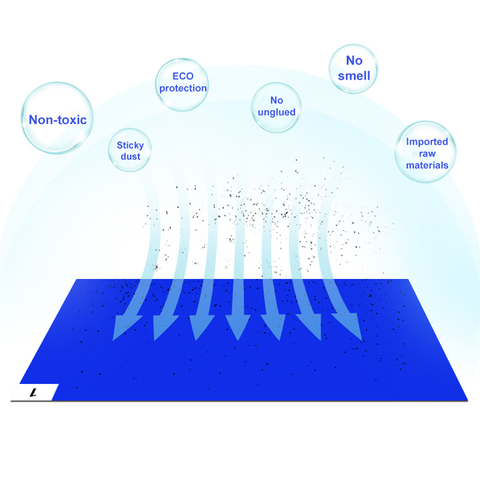
A sticky mat, also called a tacky mat or cleanroom mat,Sticky mats can be temporary or permanent. Temporary sticky mats are made of a stack of adhesive plastic film layers that are periodically peeled off and discarded. Permanent mats are made of a polymer, usually polyester- or polyvinyl chloride-based, that binds particles through electrostatic forces.
We have over 15 years manufacturing experience in the field of sticky mat . Our products are of high quality, durable and have a particularly stable astickiness. In addition, we have a variety of styles for you to choose from, and we have the ability to provide you with customized services.The cubic resistance is about from 10^4 to10^9/cm and will not be effected by environment, humidity, temperature. That's why you choose us.
A sticky mat with an adhesive surface that is placed at the entrances or exits to certain workplaces to remove contaminants from the bottoms of footwear and wheeled carts such as hand trucks. They are an example of an engineering control within the hierarchy of hazard controls.
Sticky Mat for Cleanroom Entrance Dust Control, ESD Areas and Contamination Management
LEENOL sticky mats are designed for entrances, transition zones and controlled areas where footwear and wheels can carry dust and particles into cleaner environments. The range includes disposable multilayer tacky mats, antibacterial versions, anti-static sticky mats, washable PU mats and customized products. The category is especially relevant to cleanroom operators, electronics factories, laboratories, hospitals, precision manufacturing sites and distributors that need a repeatable entrance-contamination control consumable.
What a Sticky Mat Does in a Facility
A sticky mat provides a simple physical control at the boundary between a general area and a cleaner or more controlled space. When an operator walks across the adhesive surface, dust and loose particles on the shoe sole are captured before the person enters the controlled zone. Carts can also pass over suitable mats to reduce the transfer of dirt on wheels. LEENOL describes sticky mats as products used at entrances and exits to remove contaminants from footwear and wheeled carts.
The value of a tacky mat is therefore linked to placement and operating discipline. A mat installed where nobody walks over it will have little effect. Likewise, a heavily contaminated surface that is not replaced or peeled will become less useful. For B2B procurement, the mat should be treated as part of an entrance-control procedure with defined placement, replacement frequency, floor preparation and inventory replenishment.
Disposable Multilayer Construction
A representative LEENOL cleanroom sticky mat, model LN-1550095B_KJ2645B-45, is listed at 0.045mm/45µm thickness and 26×45 inches, with a multilayer PE film structure and water-based pressure-sensitive adhesive. The listed colors include blue, white, transparent, green and red. Each adhesive layer can be used separately; when the top layer becomes dirty, it is peeled away to expose a fresh surface. Digital labels on the layers help operators identify the replacement sequence.
LEENOL also lists 30-layer 35µm products, 30µm anti-static and antibacterial versions, 40µm antimicrobial products and 45µm sizes in multiple dimensions. This provides purchasing flexibility when the customer has different doorway widths or replacement frequencies.
Sticky Mat Comparison
| Mat type | Typical construction | Best suited to | Main procurement considerations |
|---|
| Disposable multilayer tacky mat | PE film with adhesive layers | Cleanroom entrances and high-turnover areas | Layer count, thickness, size, adhesive tack, replacement rate |
| Anti-static sticky mat | Multilayer mat with ESD-related customization | Electronics workshops and ESD areas | Static performance, entrance layout and compatibility with ESD program |
| Antibacterial sticky mat | Disposable multilayer structure with antibacterial option | Laboratory and selected medical/controlled areas | Antibacterial specification, process requirements and replacement procedure |
| Washable PU sticky mat | Washable PU material | Applications needing reusable cleaning control | Cleaning method, adhesion retention, floor compatibility and service life |
Key Parameters for B2B Purchasing
Important parameters include length and width, film thickness, number of layers, adhesive viscosity, base adhesion, color, antibacterial or antistatic function, packaging and floor compatibility. LEENOL provides several common sizes including 18×36, 24×36, 18×45, 26×45, 24×45 and 36×45 inches, with thickness options from 30µm to 45µm on the referenced product information.
Entrance dimensions should determine mat size. A mat that is too short may not provide enough foot contacts, while an unnecessarily large mat can increase consumable cost and interfere with doors or carts. The procurement team should measure the actual entrance, door swing, traffic direction and cart path before selecting a size. For high-traffic sites, compare layer thickness and replacement interval rather than price per individual mat alone.
Cleanroom, Laboratory and Electronics Applications
LEENOL lists cleanrooms, laboratories, electronics workshops, ESD areas, buffer zones, semiconductor-related areas, precision manufacturing and warehouse entrances among suitable applications. In an electronics factory, a tacky mat can be positioned at the transition from a general corridor to an EPA or cleaner assembly area. It can help reduce dust without being confused with an electrical grounding device.
Laboratories can use sticky mats at controlled-access points where particle transfer needs to be minimized. Medical and biological applications require additional evaluation of the exact product, hygiene procedure and regulatory requirements. The presence of an “antibacterial” option does not by itself establish suitability for a particular clinical or sterile process; the buyer should match the product documentation to the site's procedures.
Installation and Replacement Procedure
Before installation, the floor should be dry, flat and free of oil, loose dust and moisture. Position the mat where foot traffic or wheels naturally cross the entrance. Remove the transparent protective layer before use. Operators then walk across the adhesive surface so particles are captured. When the surface becomes visibly contaminated or no longer performs as required, peel off the used layer according to its numbered label and expose the next clean layer.
For a facility management team, replacement can be standardized by area: high-traffic entrances may require more frequent changes than low-traffic laboratory doors. Recording layer changes can also help purchasing teams estimate monthly consumption and avoid stockouts.
Related LEENOL ESD and Cleanroom Products
For an electronics facility, pair an ESD personnel grounding solution with entrance contamination control when the process requires both. Operators can also use ESD gloves for static-sensitive handling and select ESD clothing for personnel static control. These products solve different process risks and should be specified according to the site's ESD and contamination-control plan.
Customization for Different Entrance Layouts
LEENOL states that sticky mats can be customized in size, color, packing, thickness and viscosity, with antibacterial and antistatic functions available according to requirements. This is useful for customers with non-standard doorways, private-label distribution, color-coded hygiene zones or special ESD programs. A custom inquiry should include the doorway dimensions, traffic volume, desired thickness, number of layers, adhesive requirement, color, packaging format, annual consumption and any antistatic or antibacterial requirement.
For distributors, it is helpful to define carton quantity, individual packing, private-label artwork and barcode requirements. For factory projects, provide a floor photo or drawing and identify whether the mat is for pedestrians, carts or both. Use the LEENOL Contact Us page to send these requirements for sampling and quotation.
FAQ
How does a disposable sticky mat work?
Its adhesive surface captures dust and particles from shoe soles and suitable cart wheels. When the layer becomes contaminated, it can be peeled away to reveal the next clean layer.
What sizes are available?
LEENOL lists several sizes, including 18×36, 24×36, 18×45, 26×45, 24×45 and 36×45 inches, with multiple thickness options.
Can sticky mats be anti-static or antibacterial?
Yes. LEENOL lists anti-static and antibacterial customization options for selected sticky mat products. The exact specification should be confirmed for the intended application.
Is a sticky mat a substitute for ESD grounding?
No. A sticky mat is primarily an entrance contamination-control product. An ESD grounding system should be specified separately where personnel or equipment grounding is required.
 English