
| Material: | Type: |
| Plastic | Tray packaging |
| Plastic Type: | material: |
| PP | eco-friendly |
| Process Type: | usage: |
| Blister | packing and transport |
| Custom Order: | Color: |
| Accept | Customized |
| Place of Origin: | Size: |
| Guangdong, China | Customized Size |
| Brand Name: | Logo: |
| ksm | Customer's Logo |
| Model Number: | Thickness: |
| ksmt-t0101 | 0.25mm~1.5mm |
| Use: | Certificate: |
| Electronic | ISO9001:2008 |
| Blister trays: | Plastic trays: |
| ESD tray | PP tray |
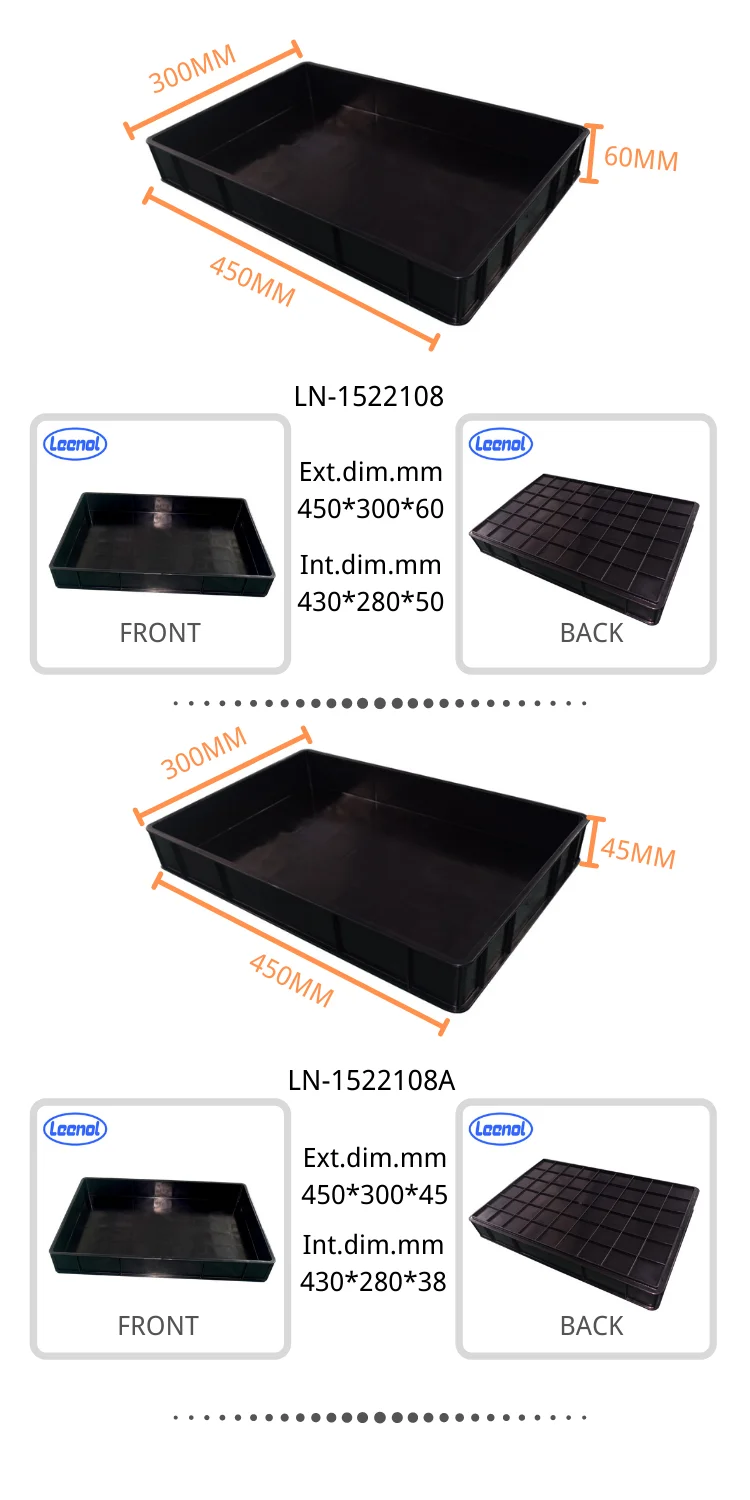
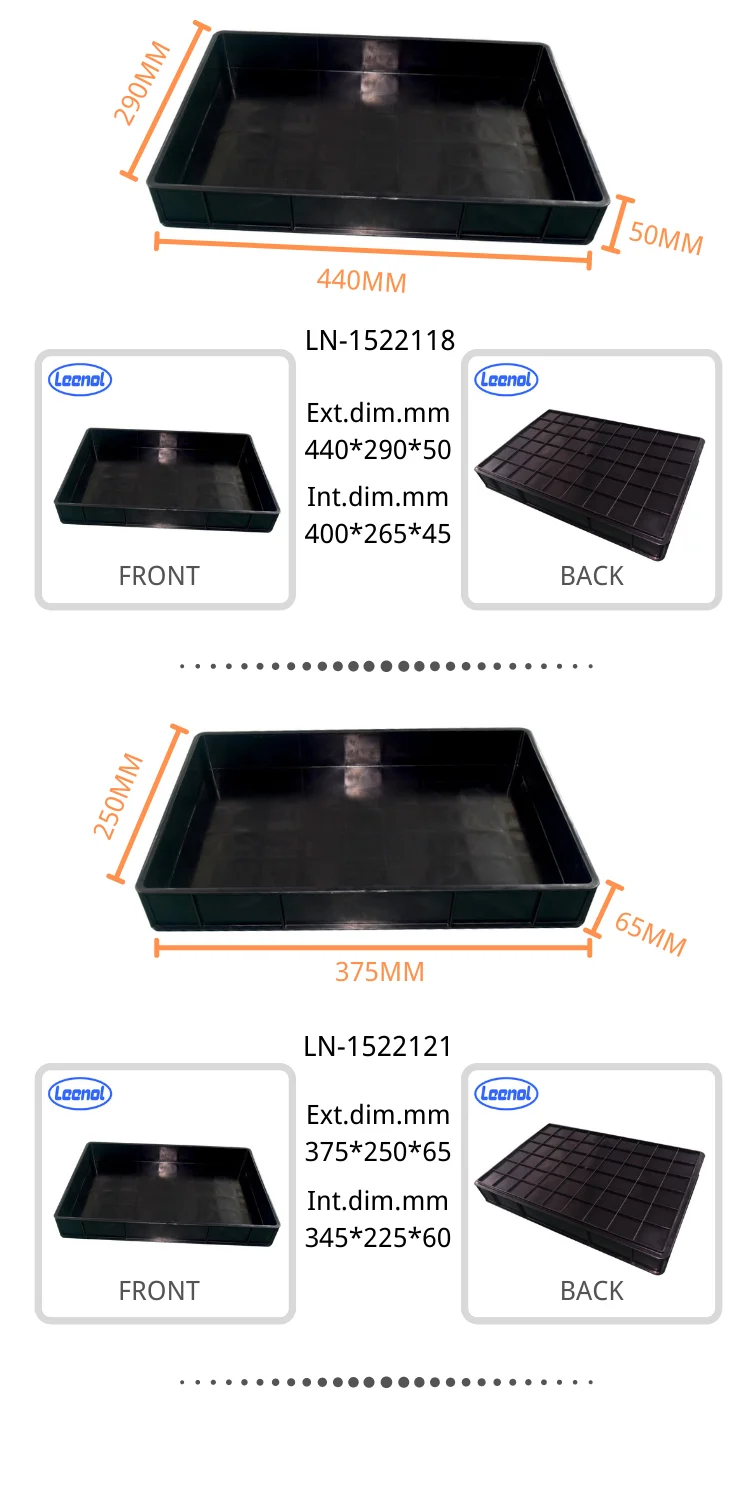
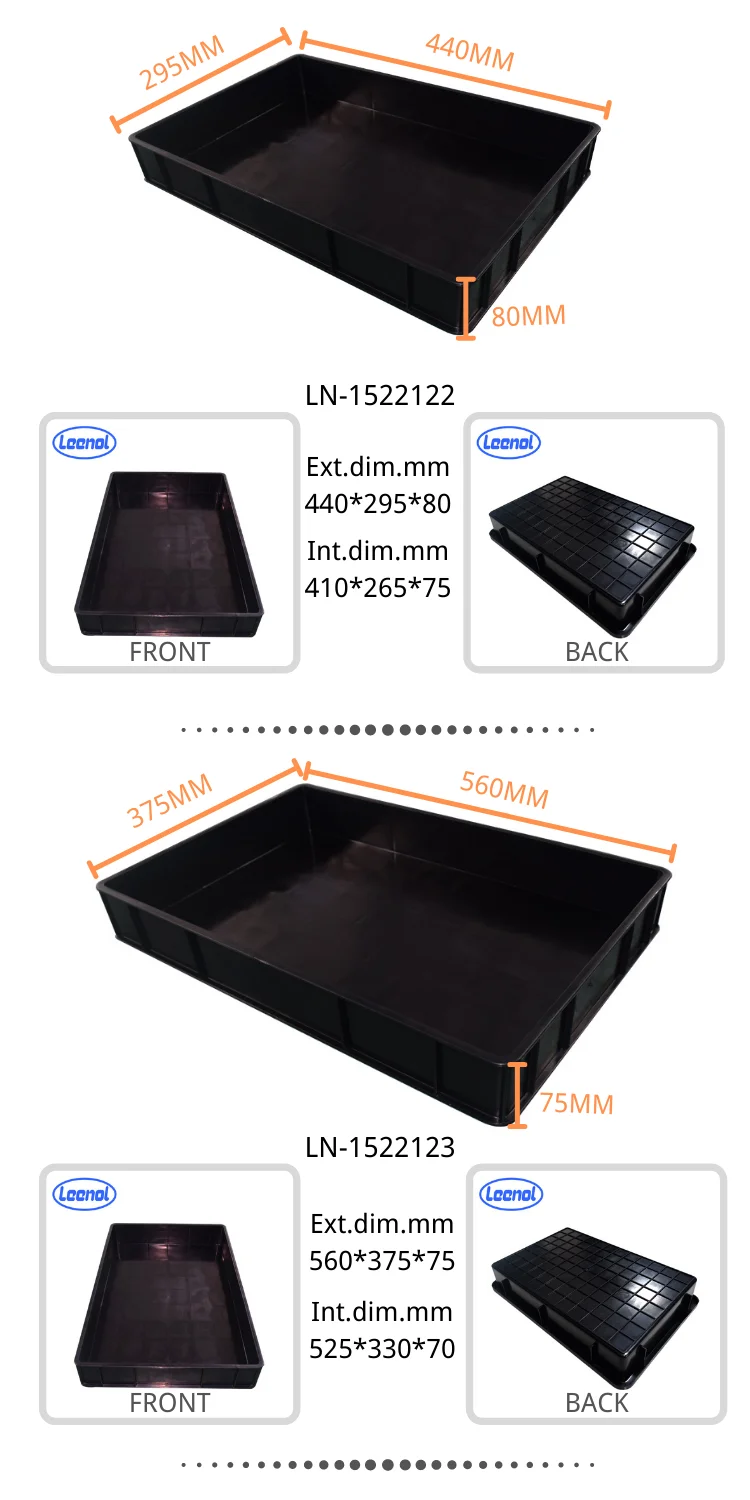
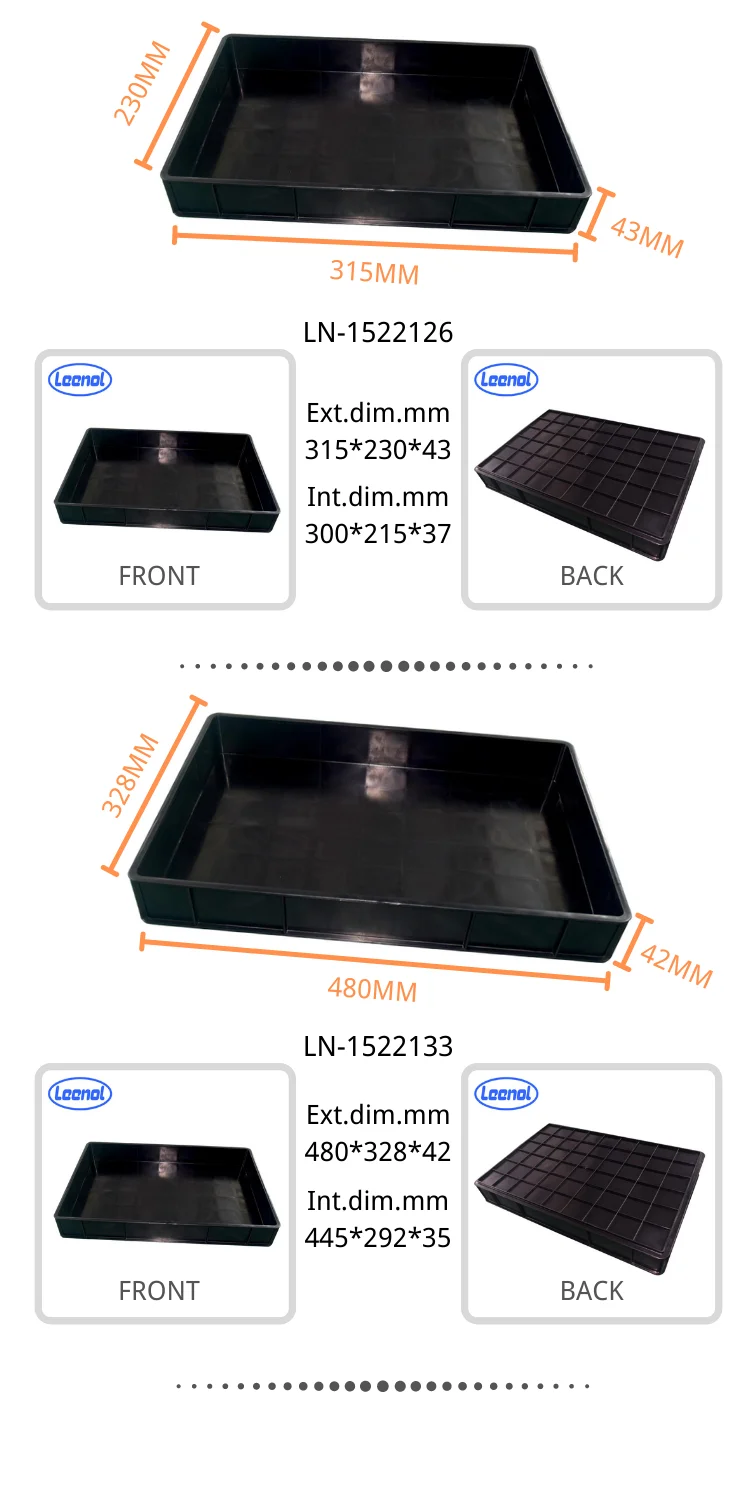
LN-1522118
LEENOL
| Ext.dim.mm(LxWxH): | |
|---|---|
| Int.dim.mm(LxWxH): | |
| Availability: | |
| Quantity: | |
| Item | Product Information |
|---|---|
| Product Name | ESD Plastic Storage Tray |
| Model | LN-1522118 |
| Brand | LEENOL |
| Material | Anti-static PP material |
| Color | Black |
| External Dimensions | 440 × 290 × 50 mm |
| Internal Dimensions | 400 × 265 × 45 mm |
| Structure | Reinforced bottom and side walls |
| Surface Design | Smooth, burr-free edges |
| Storage Design | Stackable |
| Primary Use | Electronic component handling and storage |
| Suitable Processes | Circulation, sorting, storage, packing and transportation |
| Product Category | ESD bins and trays |
The product page does not publish the surface resistance, volume resistance, load capacity, operating temperature or stacking limit. These values should be confirmed with LEENOL according to the intended application.
Electronic components frequently pass through several process stages before becoming part of a finished product. They may move from incoming inspection to material preparation, assembly, testing, rework, final inspection and packing.
Using unsuitable open containers during these movements can make components more difficult to organize and may increase the risk of mixing, contamination, physical impact or uncontrolled handling.
The LN-1522118 ESD tray provides a defined storage and circulation area for electronic parts. It can be positioned on ESD workbenches, shelving systems, trolleys, inspection tables and material preparation stations according to the factory workflow.
Its anti-static material is intended to support electrostatic control when the tray is used within a properly managed ESD environment. The tray should not be regarded as a complete ESD protection system by itself.
ESD PLASTIC STORAGE ELECTRONICS TRAY
1.Material: anti-static new PP material;
2.The anti-static plastic tray can effectively release the static charge accumulated on the surface of the object, so that it will not produce charge accumulation and high potential difference.
3.The anti-static blister tray has many advantages such as toughness, wear resistance, moisture and corrosion resistance, heat insulation, shock resistance, economy and durability.
The anti-static blister tray can greatly reduce the damage rate of electronic products during the production and transportation process, and reduce the cost. , Improve product quality and profit;
4.The main purpose of the anti-static blister tray: eliminate static electricity and protect precision electronic components; it is widely used in the turnover, packaging, storage and transportation of electronic devices.
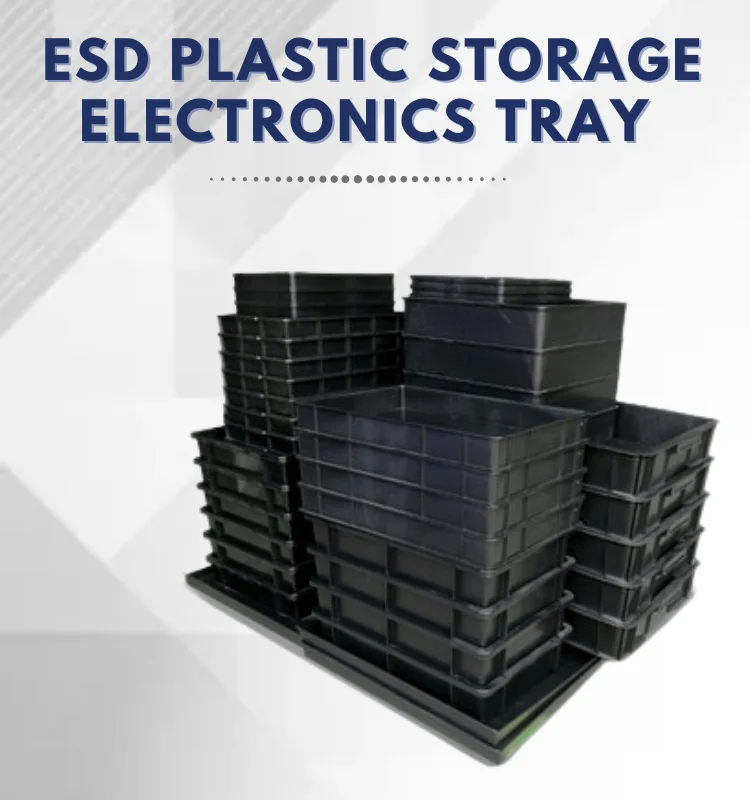
ESD anti-static blister tray electronic tray
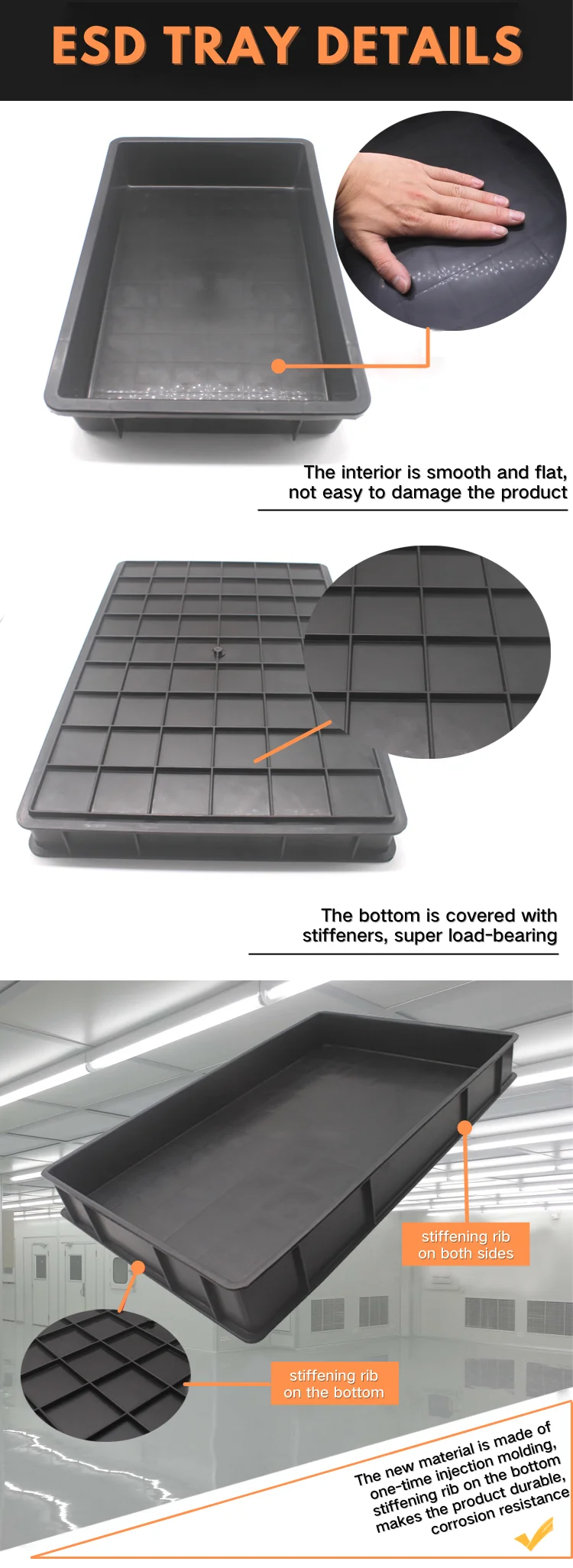
The tray is made from anti-static PP material for use around electronic components and related products.
Polypropylene provides a practical base material for reusable industrial storage containers. The product page identifies the material as new anti-static PP rather than recycled mixed plastic.
The anti-static function is intended to help control charge accumulation on the tray surface. However, the exact electrical resistance range and testing method are not provided and should be confirmed before the tray is used for components with defined ESD sensitivity requirements.
Reinforcing ribs are incorporated into the bottom of the tray. This structural design helps improve rigidity and supports the tray during regular handling, storage and internal transportation.
The reinforced base also helps the tray remain stable when placed on workbenches, shelves or factory trolleys.
The actual load capacity depends on the component weight, load distribution, stacking method and operating environment. A specific load value should not be assumed without technical confirmation.
Reinforcing structures are also positioned around the four sides of the tray. These features help the container maintain its form during repeated production circulation.
The reinforced sides are useful when trays are manually lifted, positioned on shelves or moved between different operating areas.
The product surface is described as smooth and free from burrs. Smooth edges help reduce sharp contact points during manual handling and make the tray more suitable for routine use by assembly, inspection and warehouse personnel.
A smooth internal surface also makes it easier to place and remove components without unnecessary obstruction.
The trays can be stacked to reduce the amount of floor, shelf and trolley space required during storage or transportation.
Stacking can help factories organize empty trays, work-in-process components and prepared material batches. It may also simplify tray return and internal logistics between production departments.
Before stacking loaded trays, operators should confirm that the tray arrangement is stable and that the combined weight does not exceed the applicable operating limit.
With an internal height of 45 mm, the LN-1522118 uses a relatively shallow open design.
This format provides direct access to stored parts and allows operators to identify contents more easily during assembly, inspection and material preparation.
The tray is more suitable for components that fit securely within its internal dimensions. Small loose parts may require additional dividers, inserts, bags or compartment containers.
The rigid PP construction supports repeated use in electronics production and warehouse circulation.
Reusable trays can help companies standardize component handling across incoming material areas, production lines, testing stations and finished-product preparation areas.
The tray should be inspected and cleaned according to the facility’s ESD and material-control procedures before being returned to service.
The tray can be used to hold electronic components during short-term storage at material preparation, production and inspection stations.
Its open structure allows operators to see and access stored items without opening a lid.
Printed circuit boards and assembled circuit boards can be placed in the tray when their dimensions and required protection are compatible with the available internal space.
For boards requiring separation, cushioning or positioning, additional ESD-compatible inserts or dividers may be needed.
Production operators can use the tray to organize components, subassemblies and work-in-process products beside ESD workstations.
Different trays may be assigned to separate production orders, component types or processing stages.
The tray may be used in SMT supporting areas for preparing suitable components, tools, feeder-related items or materials before they are transferred to the production line.
The tray should not replace specialized PCB magazine racks or reel storage products when those formats are required.
Inspection teams can use the tray to separate products waiting for inspection, approved components, rejected parts and items requiring additional review.
Clear identification procedures should be used to prevent different material statuses from being mixed.
Repair technicians can place removed parts, replacement components and work-in-process assemblies in separate trays.
This helps keep the workstation organized and reduces the chance of parts being misplaced during troubleshooting and rework.
Warehouse personnel can use the tray to pick and distribute electronic components to production departments.
Labels or identification cards can be added to support part-number, batch-number and production-order management.
The reinforced and stackable structure supports movement between storage, production, testing and packaging areas.
The tray may be placed on suitable ESD trolleys, shelves or material-handling equipment according to the facility layout.
Finished electronic components or small assemblies can be organized in the tray before they are transferred into the final packaging process.
Where shielding, moisture protection or impact cushioning is required, the tray should be combined with appropriate ESD packaging materials.