English
Views: 336 Author: Site Editor Publish Time: 2026-08-26 Origin: Site


When selecting ESD Gloves for electronics manufacturing, two conductive materials appear frequently: carbon fiber and copper fiber. Both are used to control electrostatic charge, and both can be incorporated into lightweight gloves for handling circuit boards, semiconductors, precision instruments, and other static-sensitive products.
At first glance, the choice may seem simple. Copper is a highly conductive metal, so copper fiber gloves must provide better ESD protection. In practice, however, glove performance is not determined by the conductivity of the raw material alone.
The amount of conductive fiber, yarn structure, knitting pattern, contact between fibers, surface resistance, coating, washing durability, glove fit, and connection to the wider ESD control system all influence how a glove performs.
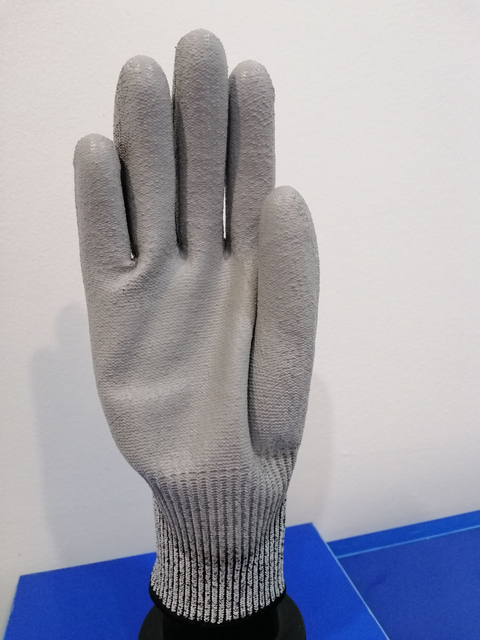
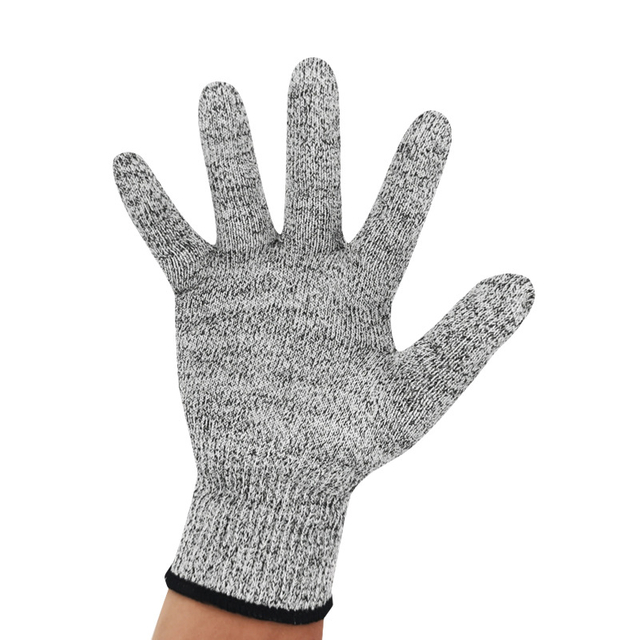
Carbon fiber ESD gloves are generally valued for their lightweight construction, flexibility, resistance to repeated bending, and stable performance in routine electronics production. Copper fiber ESD gloves use metallic conductive elements that can provide efficient charge movement and are often selected where a highly conductive textile structure is preferred.
LEENOL currently lists both carbon fiber and copper fiber ESD Gloves for electronics and precision manufacturing applications, with typical surface resistance values in the static-dissipative range.
Understanding what actually separates the two materials makes it easier to select the right glove for a specific production line.
Ordinary textile fibers are selected mainly for properties such as comfort, strength, elasticity, and durability. Polyester and nylon, for example, are widely used in industrial gloves because they can be knitted into lightweight, close-fitting fabrics.
But ordinary synthetic fibers are not automatically suitable for controlling electrostatic charge.
Movement between different materials can generate static electricity through contact and separation. An operator may build up charge while walking, moving in a chair, handling packaging, touching equipment, or manipulating components.
In an electronics assembly environment, uncontrolled charge can become a problem when the operator handles electrostatic-sensitive devices.
Conductive ESD gloves address this by introducing conductive fibers into the textile structure.
These conductive elements create paths through which charge can spread and dissipate instead of remaining concentrated on an insulating surface.
The basic goal is therefore similar whether carbon or copper is used.
The difference lies in how each material creates that conductive network and how it behaves during real industrial use.
 | 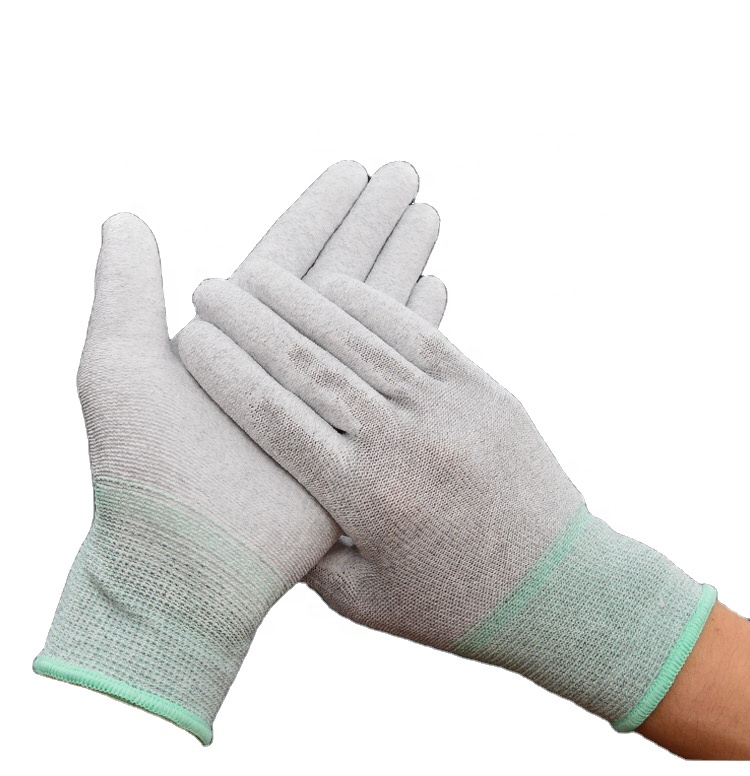 |  |
Carbon fiber ESD gloves normally contain fine carbon-based conductive filaments integrated into polyester, nylon, or another textile base.
These are not the thick structural carbon-fiber materials commonly associated with aircraft panels or automotive body parts. In ESD clothing and gloves, the conductive element is much finer and is designed specifically for textile processing.
Carbon-containing fibers can be distributed through the glove as regular conductive lines or patterns.
When these fibers form a sufficiently connected network, electrical charge can move through that network instead of remaining isolated on the glove surface.
One advantage of carbon-containing conductive yarn is that it can be manufactured into very fine fibers.
That allows it to be combined with lightweight textile materials without making the glove excessively bulky.
Carbon-based conductive elements also tolerate repeated bending well. This matters because fingers flex thousands of times during a production shift.
For an operator installing components or inspecting circuit boards, a glove must maintain its conductive function while repeatedly stretching and bending around the fingers.
Carbon also does not rust in the same way untreated metallic fibers can. This can be useful where gloves are washed and reused according to the manufacturer's instructions.
As a result, carbon fiber ESD gloves are common in production areas where employees need a combination of static control, dexterity, breathability, and long-duration comfort.
Copper fiber ESD gloves use copper-containing conductive yarn or metallic conductive elements within the fabric.
Copper has very high intrinsic electrical conductivity. When incorporated correctly into a glove, it can provide an efficient path for charge movement.
However, the fact that copper itself is highly conductive does not mean every copper fiber glove automatically has dramatically lower surface resistance than every carbon fiber glove.
The final electrical behavior is determined by the complete glove construction.
This includes:
The amount of copper-containing fiber
Fiber spacing
Yarn construction
Knitting density
Continuity between conductive yarns
Surface coating
Moisture and contamination
Contact with the operator
Grounding conditions
LEENOL's copper fiber glove specifications describe copper-containing fibers as providing rapid static-charge dissipation, while listing typical surface resistivity in approximately the same 10⁶–10⁹ Ω range used for its carbon ESD glove category.
This is an important practical point for buyers.
A more conductive raw material does not necessarily mean the complete glove should have the lowest possible resistance. An ESD control product needs to provide controlled charge dissipation appropriate to the application.
At the raw-material level, copper is substantially more electrically conductive than carbon-based textile fibers.
In a finished pair of ESD Gloves, however, raw-material conductivity is only one variable.
Carbon fiber gloves can be engineered to provide a stable conductive or static-dissipative network across the knitted fabric. Copper fiber gloves can likewise be engineered so that metallic fibers provide a continuous path for charge movement.
This means buyers should compare actual measured glove performance rather than making a decision from the material name alone.
It is easy to assume that the ESD glove with the lowest resistance must be the safest glove.
Electrostatic control is more complicated than that.
In many electronics applications, the objective is to control charge and provide a predictable dissipation path. The glove operates together with the worker, flooring, wrist grounding, footwear, workbench, clothing, packaging, and other ESD controls.
Therefore, conductive ESD gloves should be evaluated according to the required resistance range and the facility's ESD control program rather than simply selecting whichever material conducts electricity most strongly.
This is why two gloves made from very different conductive fibers can still be designed to work within similar electrical resistance ranges.
For repetitive precision work, carbon fiber constructions often have a practical advantage in textile flexibility.
Carbon-containing conductive yarn can be integrated into lightweight polyester or nylon knitting without requiring a large amount of metallic material.
The result can be a thin glove that follows finger movement closely.
This is useful for:
Microelectronic assembly
PCB inspection
Connector installation
Semiconductor handling
Precision instrument assembly
Optical equipment work
Electronics repair
A close-fitting glove makes it easier for operators to feel small components and maintain controlled finger movement.
Copper-containing conductive yarn can also be manufactured into flexible gloves. Modern conductive yarns do not necessarily behave like rigid metal wire.
However, the exact tactile feel depends strongly on how the metallic element is incorporated into the yarn.
For this reason, electronics factories should test actual samples instead of assuming that all copper fiber or carbon fiber gloves will feel identical.
Comfort becomes increasingly important when workers wear gloves for six, eight, or more hours during repetitive production.
A technically effective glove that causes excessive sweating, finger fatigue, or restricted movement may not perform well in real operations because workers will constantly adjust or remove it.
Carbon fiber ESD gloves are widely used for routine electronics production partly because their conductive yarn can be incorporated into lightweight knitted liners.
This allows the underlying polyester or nylon structure to provide breathability and stretch.
Copper fiber gloves can also be suitable for extended wear, particularly when the metallic yarn content is carefully controlled.
The better option should be determined from:
Glove weight
Knitting density
Fiber composition
Size
Breathability
Elasticity
Seamless construction
Coating coverage
Material alone does not determine operator comfort.
For ESD gloves for electronics assembly, manufacturers should therefore evaluate comfort and electrical performance together.
Reusable gloves are often washed several times during their service life.
This makes durability of the conductive network important.
Carbon-containing conductive fibers have an advantage because the conductive material can be integrated directly into the textile fiber rather than depending on an external metal surface.
Copper-based conductive yarns can also provide durable performance, but their long-term behavior depends on the yarn structure and how the copper is protected.
Metallic materials can react with environmental conditions differently from carbon-based materials.
Repeated exposure to moisture, chemicals, detergents, or unsuitable washing conditions may affect some metal-containing textile structures.
This does not mean copper fiber gloves cannot be reused. It means buyers should check the manufacturer's recommended cleaning method and verify performance after repeated laundering when reuse is part of the production process.
Using an ESD glove outside its recommended washing conditions can change more than appearance.
Improper laundering can affect:
Conductive yarn
Coatings
Glove size
Surface residues
Textile strength
Particle generation
Electrical resistance
Factories that reuse ESD cleanroom gloves or general electronics gloves should therefore establish a controlled cleaning and replacement policy.
Carbon is generally valued for chemical stability and resistance to corrosion.
This characteristic makes carbon-containing conductive yarn attractive for reusable ESD textiles.
Copper is also durable, but exposed copper can oxidize over time under certain environmental conditions.
In a well-designed conductive yarn, manufacturers may use fiber construction, blending, plating, coatings, or other techniques to protect metallic conductive elements.
That means the practical difference varies considerably between glove designs.
A buyer should not reject copper gloves simply because copper can oxidize, nor assume that every carbon glove will remain electrically unchanged indefinitely.
The relevant question is whether the finished glove maintains its specified performance under the expected operating, cleaning, humidity, and chemical conditions.
For general precision assembly, carbon fiber ESD gloves are often a practical choice.
They can combine:
Lightweight construction
Good flexibility
Stable static-dissipative properties
Breathability
Washability
Repeated bending resistance
These characteristics fit PCB assembly, electronic component installation, inspection, repair, testing, and similar tasks.
LEENOL specifically positions its carbon fiber gloves for electronics assembly, optical equipment work, semiconductor production, and cleanroom applications.
Copper fiber ESD gloves can also be appropriate for precision assembly, especially where users prefer a metallic conductive yarn structure or where rapid charge movement is an important design consideration.
LEENOL lists copper fiber gloves for electronics, aerospace, biopharmaceutical, and other precision-controlled environments.
The choice therefore depends on more than the industry name.
Cleanroom applications introduce another variable: particle contamination.
An ESD glove may provide suitable electrical performance but still be unsuitable for a controlled environment if the textile releases too many particles.
For this reason, ESD cleanroom gloves need to be evaluated for both static control and cleanliness.
LEENOL's carbon fiber glove specifications identify a low-particle-shedding construction intended for semiconductor and cleanroom applications.
When comparing carbon and copper options for a cleanroom, buyers should examine:
Particle shedding
Textile construction
Packaging method
Cleanliness
Surface resistance
Glove washing procedure
Residue requirements
Process compatibility
The conductive fiber is only part of the specification.
A carbon glove designed for cleanroom work may be more suitable than a generic copper glove, while a properly manufactured cleanroom copper fiber glove may be suitable for another process.
The finished product should be judged against the facility's actual cleanliness requirements.
Many anti static gloves for electronics include polyurethane coating on the fingertips or palm.
This coating primarily affects mechanical handling rather than determining whether the conductive network is carbon or copper based.
PU-coated fingertips can improve friction when handling:
Small circuit boards
Smooth electronic components
Connectors
Glass components
Precision tools
Palm coating provides a larger gripping surface and can increase abrasion resistance.
Both carbon fiber and copper fiber glove constructions can be combined with grip-enhancing coatings.
Therefore, PU coating should be considered as a separate selection variable.
First determine the conductive fiber and electrical performance required. Then determine whether the workstation needs bare textile fingertips, fingertip coating, or palm coating.
There is no universal answer because glove life depends on construction and working conditions.
Carbon-containing yarn has useful resistance to repeated flexing and does not face the same corrosion mechanism as untreated copper.
This can make carbon fiber gloves well suited to repeated everyday use.
Copper fiber gloves may offer excellent durability when the metallic conductive yarn is properly engineered and protected.
In real production, other components of the glove may wear out before the conductive material itself.
Typical failure points include:
Fingertips
Palm coating
Knitted fabric
Elastic cuffs
Seams or knitted edges
For this reason, conductive gloves for electronics should be inspected regularly rather than kept in service until they visibly fail.
A glove with torn fabric, damaged conductive yarn, peeling coating, heavy contamination, or major deformation should be removed from use.
Copper-containing conductive materials can cost more than carbon-based conductive yarn in some constructions, but glove pricing is not determined by conductive material alone.
Cost is influenced by:
Conductive fiber percentage
Base fabric
Knitting technology
Coating
Cleanroom processing
Packaging
Quality control
Size range
Order quantity
Customization requirements
A lower-priced glove can also become more expensive over time if it wears quickly or requires frequent replacement.
Instead of comparing unit price only, electronics manufacturers should consider service life, washability, production suitability, worker comfort, and quality consistency.
The decision becomes easier when the application is considered first.
Carbon fiber gloves can be a strong option when the production line prioritizes:
Lightweight construction
Long-hour comfort
Flexible finger movement
Repeated bending
Routine PCB and electronics assembly
Washability
Cleanroom-compatible options
Stable general-purpose ESD control
They are particularly practical for high-volume electronics manufacturing where operators perform repetitive fine-motor tasks.
Copper fiber gloves may be worth considering when the application prioritizes:
A metallic conductive fiber structure
Efficient charge movement
Strong conductive pathways
Specialized electronics work
Aerospace or precision manufacturing
Applications where copper-containing conductive yarn is specified
The final selection should still be based on verified surface resistance, glove construction, comfort, cleanliness, durability, and compatibility with the complete ESD control system.
Instead of asking suppliers only whether a glove contains carbon or copper, purchasing teams should request a broader set of information.
Important specifications include:
Check the measured electrical resistance and confirm that it matches the requirements of the production environment.
LEENOL currently lists both carbon fiber and copper fiber ESD glove categories with typical surface resistance or resistivity around 10⁶–10⁹ Ω.
Ask how the conductive material is incorporated into the glove.
The spacing, continuity, and distribution of conductive yarn can influence performance as much as the material itself.
Polyester and nylon constructions can behave differently in terms of comfort, stretch, wear, and moisture handling.
Determine whether the task requires uncoated fingers, PU fingertips, or palm coating.
For semiconductor and cleanroom applications, request information about particle shedding and cleanroom compatibility.
If gloves will be reused, ask about recommended washing conditions and expected performance after repeated cleaning.
Production samples should be tested by actual operators.
A glove may meet the electrical specification but still be unsuitable if it interferes with component handling.
Carbon and copper are useful conductive materials, but neither material tells the whole story.
Two carbon fiber gloves from different manufacturers can have different resistance, fiber density, grip, cleanliness, durability, and comfort.
The same is true for copper fiber products.
For that reason, buyers should compare finished-glove specifications rather than treating "carbon" or "copper" as a complete performance rating.
The right ESD Gloves are the ones that maintain appropriate electrical performance while allowing operators to complete their actual work accurately and comfortably.
A PCB assembly worker, semiconductor technician, aerospace production operator, and cleanroom inspector may all require ESD protection, but they do not necessarily need the same glove.
Copper has higher intrinsic electrical conductivity than carbon-based conductive materials. However, the electrical performance of a finished glove depends on conductive fiber content, spacing, yarn design, knitting structure, and other factors. Buyers should compare the measured surface resistance of the complete glove rather than relying only on the raw material.
Yes. Carbon fiber ESD gloves are widely used for PCB assembly, inspection, semiconductor handling, electronics repair, and other precision work. Their lightweight knitted construction can provide a useful balance between static control, dexterity, breathability, and comfort.
Yes. Different conductive materials can be engineered into gloves that operate within similar resistance ranges. For example, LEENOL currently specifies typical values around 10⁶–10⁹ Ω for both its carbon fiber and copper fiber ESD glove categories.
Carbon-containing conductive yarn is commonly used in reusable ESD textiles because it tolerates repeated flexing and does not rust like untreated metal. However, both carbon and copper fiber gloves should be cleaned according to the manufacturer's instructions. The finished glove's verified post-wash performance is more important than material assumptions.
Manufacturers should choose ESD Gloves according to the actual resistance, cleanliness, grip, durability, and operator requirements of each workstation rather than relying only on the conductive fiber name. LEENOL supplies carbon fiber ESD gloves, copper fiber ESD gloves, nylon anti-static gloves and other ESD personal protective products for electronics, semiconductor, cleanroom, laboratory and precision manufacturing environments. As an ESD TOTAL SOLUTION provider, LEENOL also supplies ESD workbenches, storage equipment, packaging materials, clothing, cleanroom products, testing equipment and other electrostatic-control products, allowing factories to build a more coordinated ESD protection system around their actual production processes.