English
Views: 0 Author: Site Editor Publish Time: 2026-07-11 Origin: Site


ESD Clothing is easy to buy badly.
That usually does not mean the garment is fake or completely unusable. More often, the clothing is simply wrong for the job. A short-sleeve polo is ordered for an operator who works directly over exposed circuit boards. A clean-looking jacket is approved without checking how it performs after washing. A factory compares two resistance values, even though one comes from the fabric and the other from a finished garment test.
These mistakes are fairly common because ESD Clothing still looks like ordinary workwear. It has sleeves, pockets, buttons, zippers, and company colors. The conductive fibers are often the only visible difference, and even those may appear as nothing more than fine black lines in the fabric.
The purchasing decision, however, is not mainly about appearance.
The garment needs to control the influence of ordinary clothing, limit charge buildup during movement, and provide suitable coverage around static-sensitive products. It also has to be comfortable enough that employees will keep it closed, leave the sleeves down, and wear it for the full shift.
That last point should not be underestimated. A technically correct jacket does very little when operators keep rolling up the cuffs because the sleeves are too hot.
 |  |  |
Before looking at materials or resistance levels, it helps to define the role of the garment.
In some work areas, ESD Clothing is used as a basic outer layer over ordinary clothes. In others, it forms part of a more controlled personnel grounding system. A semiconductor cleanroom may also expect the garment to limit particles, cover hair and skin, and remain clean after controlled laundering.
These are not the same requirements.
A repair technician working on finished electronic equipment may only need a long-sleeve ESD jacket. A worker placing exposed chips or sensors may need much more complete coverage. Someone working in a cleanroom may require a coverall and hood rather than a jacket and separate trousers.
It is therefore worth looking at each work area separately. Choosing one uniform for the entire factory is convenient, but it can lead to over-specification in low-risk areas and weak protection in critical ones.
The term “electronics production” covers a very wide range of work.
One operator may be packing completed products into cartons. Another may be handling bare PCBs, integrated circuits, displays, sensors, or battery control components. Their clothing requirements will not necessarily be the same.
The most useful questions are practical ones.
How close does the worker get to the component? Are the parts exposed? Does the operator lean over the workbench? Can an ordinary sleeve come into contact with the product? Does the employee move between grounded and uncontrolled areas during the shift?
Once these questions are answered, the required garment style usually becomes clearer.
ESD Clothing is often worn over personal clothing or a standard company uniform. That clothing can contain polyester, nylon, wool, or other materials that generate and retain static charge.
A properly closed ESD jacket can help cover the shirt underneath. An open jacket cannot.
The same issue appears at the cuffs and collar. If the sleeve is too short, ordinary clothing remains exposed around the wrist. If the jacket is cut too tightly, employees may leave it partly open when sitting or reaching.
This is why fit is not only a comfort issue. It affects the amount of clothing that is actually covered.
Most ESD garments use polyester as the main fabric, with conductive fibers woven or knitted into the material.
Polyester is popular because it is durable, lightweight, easy to manufacture into different garment styles, and suitable for repeated washing. On its own, however, ordinary polyester is not an ESD solution. The conductive yarn in the fabric is what provides the controlled electrical path.
The yarn may be arranged in stripes, small squares, larger grids, or diamond patterns. Some grids are easy to see. Others are fine enough that the garment looks almost like normal workwear from a distance.
LEENOL’s ESD Clothing range includes conductive-grid fabrics used in jackets, polo shirts, T-shirts, coveralls, trousers, caps, and cleanroom garments. Different fabric weights and grid structures are available for different workplace conditions.
Polyester conductive fabric is a common choice for electronics assembly, SMT production, inspection areas, laboratories, and semiconductor-related work.
It usually offers a practical balance between durability, weight, and washability. Woven versions are often used for jackets and coveralls, while knitted versions are more common in polo shirts and T-shirts.
The conductive grid size may be listed in the product specification. This is useful information, but it should not be treated as the only quality indicator.
A smaller grid does not automatically guarantee better performance. Conductive yarn quality, fabric density, seams, garment design, and test results all affect the finished product.
Polyester-cotton blends are often chosen for comfort.
They can feel softer and less synthetic than pure polyester garments, which may be useful in warm workshops or areas where staff wear the clothing for long periods.
The trade-off is that blended fabrics may not be the first choice for a strict cleanroom or a process with demanding particle-control requirements.
This does not make them poor ESD garments. It simply means the base material should match the work area. A comfortable ESD polo used in a repair department has a different purpose from a low-lint coverall used in semiconductor assembly.
Knitted fabric stretches more easily and generally feels closer to normal clothing. It works well for polo shirts, T-shirts, and other garments used in less restrictive production areas.
Woven fabric holds its shape better and is easier to use in jackets, lab coats, trousers, and coveralls. It also provides more structure around cuffs, zippers, seams, and pockets.
Neither construction is automatically superior.
A knitted shirt may be the more sensible choice for an inspection team working in a warm room. A woven coverall is more appropriate when the employee’s ordinary clothing needs to be fully covered.
Resistance data often causes confusion during purchasing.
One supplier may list surface resistance for the fabric. Another may provide point-to-point resistance across a finished jacket. A third may quote a broad resistance range without showing the test position or method.
The numbers may look comparable. They are not always measuring the same thing.
Surface resistance describes how electrical current moves across the surface of a material. This type of data is commonly used for conductive or static-dissipative fabrics.
It can help buyers compare materials, but it does not show the complete performance of the final garment.
Once the fabric is cut and sewn, the conductive network may be affected by seams, zippers, elastic cuffs, pockets, or decorative panels. A fabric result should therefore not be treated as a finished-jacket result.
Point-to-point resistance may be measured between two parts of the finished garment, such as one sleeve and the other.
This gives a better indication of whether the conductive structure remains connected across the clothing.
Some garments also have a defined grounding point or conductive cuff. In that case, the resistance measurement may be taken between the garment and that point.
A buyer does not need to become an electrical testing specialist, but the supplier should be able to explain what was measured.
A resistance value without a test method is only half a specification.
It is common to see buyers choose the lowest resistance figure because it appears more conductive and therefore more protective.
That is an oversimplification.
The correct range depends on the garment design, the static control program, the sensitivity of the product, and whether the clothing is intended to be grounded. The aim is controlled charge dissipation, not simply selecting the smallest number on a data sheet.
When comparing products, ask whether the result comes from new clothing or washed clothing. For reusable ESD Clothing, performance after laundering is often more useful than the first test before the garment enters service.
Garment style determines how much of the worker and their ordinary clothing is covered.
This is where many purchasing decisions become too general. A factory may label all of its garments “ESD uniforms,” even though a short-sleeve shirt and a full coverall provide very different levels of coverage.
Jackets and lab coats are widely used because they are practical.
They are easy to issue, easy to replace, and can be worn over normal work clothes. Long sleeves help cover the arms, while front fasteners reduce exposure of the shirt underneath.
For general electronics assembly, testing, laboratory work, and repair areas, a jacket is often enough.
The details still matter.
The garment should remain closed when the worker sits or bends. Sleeves should reach the wrists without interfering with hand movement. Cuffs should not be so loose that they slide back during work.
Pockets should also be considered. Large open pockets may be convenient, but workers sometimes place ordinary plastic items, personal phones, or uncontrolled tools inside them.
Polo shirts and T-shirts are usually chosen for comfort.
They suit warmer workplaces, visitor uniforms, quality inspection, light assembly, repair departments, and other areas where full coverage is not required.
Employees often prefer them because they feel like normal clothing. That can improve daily compliance.
Their limitation is obvious: they do not cover as much.
A short-sleeve shirt leaves the arms exposed and does not control the electrical behavior of the worker’s trousers. It may be perfectly suitable for one work area and a poor choice for another.
The decision should come from the actual exposure risk rather than a general preference for a cooler uniform.
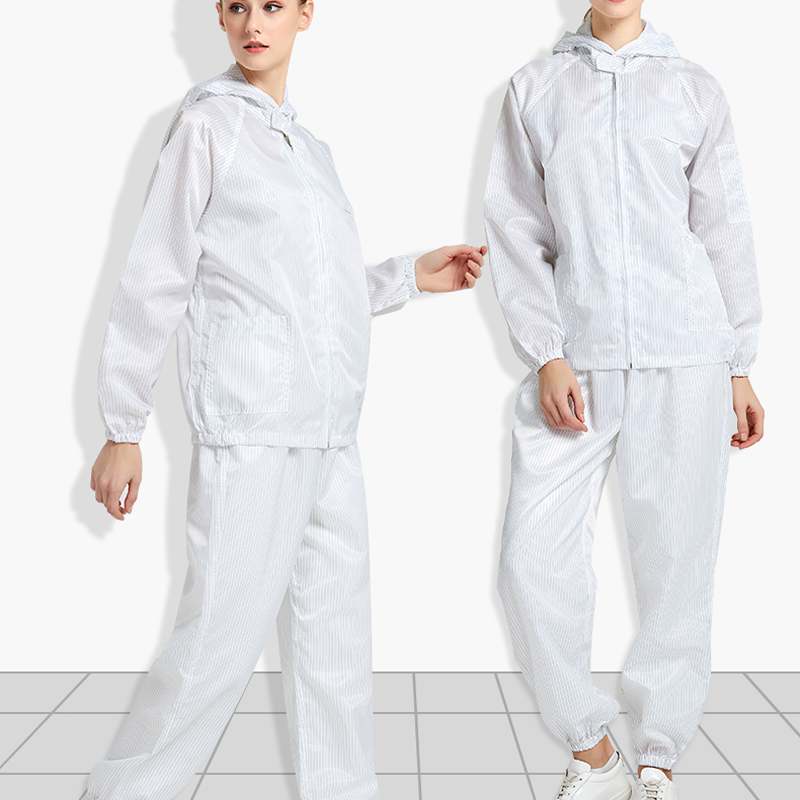
A two-piece set provides more coverage while remaining easier to put on and remove than a coverall.
This arrangement is common in automotive electronics, equipment production, testing areas, and industrial laboratories.
Two-piece uniforms are also easier to size because jackets and trousers can be ordered separately. This is useful for larger teams, where employees rarely fit one standard size perfectly from shoulder to ankle.
The waistband, seams, zippers, and pockets should still be reviewed. Nonconductive decorative materials should not be added casually to a garment that is expected to provide consistent static-control performance.
Coveralls are used when more complete coverage is necessary.
They are common in semiconductor manufacturing, cleanrooms, optical production, pharmaceutical facilities, and other controlled environments.
A coverall covers more ordinary clothing and reduces gaps between the jacket and trousers. It can also be designed with a hood, tight cuffs, and ankle closures.
The main challenge is fit.
Workers need to sit, bend, reach, and sometimes kneel while wearing the garment. A coverall that looks correct while the employee is standing may pull tightly across the shoulders or open around the wrists once work begins.
A wear trial is particularly important for this garment type.
Headwear is usually selected when static control overlaps with particle control.
An ESD cap may be suitable in an electronics workshop where the main purpose is to cover hair and provide a consistent uniform. A hooded coverall gives better coverage in a cleanroom.
The headwear should fit with masks, glasses, and other protective equipment. Gaps around the neck and sides of the face may matter in a controlled environment, even if they are not important in a normal assembly area.
The industry name alone does not determine the right garment, but it does affect which features deserve more attention.
In PCB production and electronics assembly, workers may handle bare boards, connectors, chips, sensors, or modules throughout the shift.
A long-sleeve jacket is a common starting point. It provides better coverage than a polo shirt without making the uniform unnecessarily complex.
The jacket should work alongside wrist straps, grounded benches, ESD flooring, footwear, and other site controls. ESD Clothing is not a replacement for those measures.
For workers who only handle finished housings or packaged products, a lighter garment may be enough.
Semiconductor assembly normally requires closer control.
Here, garment selection is often linked with particle generation, laundering, packaging, and traceability. A standard jacket may not provide enough coverage.
Coveralls, hoods, gloves, and compatible footwear are more common. Buyers may also need to review garment performance after repeated cleanroom laundering.
Consistency is especially important. One garment should not perform noticeably differently from another garment in the same order.
Laboratories may need ESD lab coats around electronic instruments, sensors, testing systems, or electrically sensitive samples.
The clothing should allow technicians to move easily and work with gloves, goggles, or other PPE.
An ESD coat should not automatically be treated as chemical protective clothing. If splash resistance, biological protection, or flame resistance is required, those features must be specified separately.
Automotive production now involves many static-sensitive parts, including cameras, displays, control modules, battery management systems, and power electronics.
Workers may spend more time walking between stations than employees on a fixed PCB assembly line. Garment durability and comfort therefore become especially important.
Two-piece uniforms, jackets, and polo shirts may all be used, depending on the process area.
In cleanrooms, the garment has two jobs: control static and limit contamination.
This changes the material and garment requirements.
Low-lint fabric, controlled seams, secure closures, clean packaging, and approved laundering may be just as important as resistance.
A garment described only as “anti-static” may not provide enough information for this type of application.
Comfort is sometimes treated as a soft purchasing factor, but it has a direct effect on how the garment is worn.
If the fabric is too heavy, employees open the front. If the sleeves are too long, they push them up. If the cuff is too tight, they stretch it until it no longer fits correctly.
This happens in real workplaces, even where the written procedure is clear.
Before approving a large order, give samples to employees from different roles and body sizes. Let them wear the garments during a normal shift, not only for a few minutes in a meeting room.
Check whether they can reach, sit, bend, and use tools without pulling the garment out of position.
Actual wear usually reveals more than a catalog photo.
Size labels vary between manufacturers.
One supplier’s large may fit like another supplier’s medium. This becomes a problem when a company orders hundreds of garments based on previous uniform sizes.
Use a detailed size chart.
Chest, shoulder width, sleeve length, garment length, waist, hip, and inseam measurements are more useful than S, M, L, and XL alone.
Also consider the clothing worn underneath. A winter uniform needs more room than a lightweight shirt.
For a large workforce, it is better to collect employee measurements or run a fitting session than to estimate the size split from percentages.
Reusable ESD Clothing needs a defined washing process.
Conductive fibers may be damaged by harsh chemicals, high temperatures, strong mechanical action, or unsuitable drying. Fabric softeners can leave residue on the material.
Home washing may be acceptable for some lower-control workplaces if the supplier allows it. Cleanroom garments often require professional laundering and controlled packaging.
The important point is consistency.
A garment should not be washed one way by one employee and another way by someone else. If the cleaning method is uncontrolled, it becomes difficult to know whether the resistance and cleanliness levels are still acceptable.
Garments should also be checked for damaged cuffs, broken conductive threads, open seams, failed zippers, burns, permanent contamination, and fabric thinning.
Repairs need care. An ordinary patch or nonconductive sewing thread may affect the conductive path or introduce an unsuitable material.
A useful supplier discussion should go beyond color and price.
Ask for the exact fabric composition, conductive fiber pattern, fabric weight, garment resistance data, test method, washing instructions, available sizes, and customization options.
For reusable garments, ask whether performance data is available after washing.
Samples are also important. A sample order lets the company check fit, sewing quality, pocket design, cuffs, closures, comfort, and compatibility with the current washing process.
Logo printing or embroidery should be discussed before production. Decoration should not create a large uncontrolled area or damage the garment construction.
Most ESD Clothing is made from polyester fabric containing conductive fibers. The fibers are usually woven or knitted into stripes or grids. Polyester-cotton blends are also available where comfort is a priority.
It may be enough for general PCB assembly, inspection, repair, or laboratory work when used with the site’s other ESD controls. Semiconductor and cleanroom processes may require coveralls, hoods, trousers, or more complete garment systems.
Not every garment does. Many ESD jackets are mainly used to cover ordinary clothing and reduce charge buildup. A groundable garment requires the correct design, connection, and testing.
That depends on the garment and workplace requirement. Some garments may allow controlled home washing, while cleanroom clothing usually requires professional laundering. The supplier’s cleaning instructions should be followed.
There is no fixed service life for every garment. Replacement depends on washing frequency, fabric wear, conductive fiber condition, seam damage, and electrical test results. Higher-risk workplaces usually apply stricter inspection and replacement rules.
Buying ESD Clothing should begin with the worker’s actual task.
Look at the product being handled, how close the operator gets to it, what clothing is worn underneath, and whether the area also has cleanroom requirements. Only then does it make sense to compare fabric, resistance, garment style, sizing, and price.
A comfortable polo may be suitable for an inspection team. A long-sleeve jacket may work better on a PCB line. A semiconductor cleanroom may need full coveralls, hoods, and controlled laundering. None of these choices is universally correct or incorrect.
LEENOL supplies ESD jackets, polo shirts, T-shirts, trousers, coveralls, cleanroom suits, caps, and other workplace ESD products for electronics manufacturing, laboratories, semiconductor production, automotive electronics, and controlled industrial environments. Buyers can compare different conductive fabric structures, garment styles, sizes, and customization options, then use samples and workplace trials to confirm which ESD Clothing is practical for their own production conditions.