English
Views: 0 Author: Site Editor Publish Time: 2026-09-07 Origin: Site


Improperly sized static control surfaces introduce severe operational risks to electronics manufacturing environments. When a worksurface cover does not fit the bench correctly, facilities face compromised grounding paths, accelerated component degradation, failed compliance audits, and unexpected ergonomic hazards. The core problem lies in the friction between standard industrial workbench dimensions and the actual required working area for static-sensitive assembly. Overhangs cause physical stress that leads to grounding failures. Undersized mats leave sensitive components vulnerable on insulative surfaces. Incorrect thickness selections result in rapid material wear and operator discomfort.
Establishing a reliable Electrostatic Protected Area (EPA) requires precision. Facility managers and production engineers need a systematic framework for measuring, evaluating, and selecting the exact dimensions required for an ESD mat. By accurately determining the length, width, and thickness of the worksurface material, operations can ensure strict ANSI/ESD S20.20 compliance, optimize workflow efficiency, and maximize long-term durability.
Compliance First: Sizing must account for the entire Electrostatic Protected Area (EPA) where sensitive devices are handled; partial coverage or unmanaged seams often lead to compliance failures.
The Third Dimension: Mat thickness (typically ranging from 0.060" to 0.125") is a critical sizing factor that dictates durability, ergonomic comfort, and grounding hardware compatibility.
Material Tolerances Matter: Rubber and vinyl mats have different thermal expansion and shrinkage rates that must be factored into initial measurements.
Procurement Strategy: Choosing between pre-cut, custom, or bulk roll formats depends on facility scale, standardization of workbenches, acceptable yield loss (waste), and internal installation capabilities.
Grounding Integration: Final dimensions must accommodate grounding hardware (snaps and cords) without interfering with the primary work zone or edge boundaries.
ANSI/ESD S20.20 establishes strict requirements for worksurfaces within an EPA. The standard dictates that any surface where static-sensitive devices (SSDs) are placed must possess specific electrical resistance properties to safely dissipate static charges to ground. Success is defined by maintaining a continuous, reliable working area that meets Point-to-Point (Rtt) and Point-to-Ground (Rtg) resistance thresholds, typically between 1 x 10^6 and 1 x 10^9 ohms.
Physical dimensions directly impact these electrical measurements. A worksurface must provide enough continuous surface area to accommodate the largest assemblies handled at the station, alongside any conductive tools, bins, or testing equipment. If the material is too small, operators run out of compliant space. The resistance measurements rely on the integrity of the material; any physical stress caused by poor sizing can alter the conductive layer's properties, leading to dead spots where static charge accumulates instead of dissipating.
Parameter | Test Method | Acceptable Range | Impact of Poor Sizing |
|---|---|---|---|
Point-to-Point Resistance (Rtt) | ANSI/ESD STM4.1 | 1 x 10^6 to 1 x 10^9 ohms | Seams or gaps from undersizing disrupt the continuous path, causing localized high-resistance zones. |
Point-to-Ground Resistance (Rtg) | ANSI/ESD STM4.1 | 1 x 10^6 to 1 x 10^9 ohms | Overhangs stress grounding hardware, physically breaking the connection and resulting in infinite resistance. |
Surface Area Coverage | Visual / Dimensional | 100% of active handling zone | Exposed laminate generates triboelectric charges, directly threatening component integrity. |
Undersizing creates a dangerous false sense of security on the production floor. When a worksurface cover fails to span the entire designated working zone, operators inevitably place SSDs on non-grounded peripheral areas of the bench. These exposed laminate, wood, or painted metal surfaces generate and hold static charges. Furthermore, gaps left between undersized materials and bench edges act as traps for conductive debris, solder splatter, and dust. This debris can bridge grounding paths or contaminate clean assemblies during final inspection.
Oversizing introduces a different set of physical and electrical failures. When material hangs over the edge of a workbench, gravity exerts constant downward pressure on the overhang. This mechanical tension fractures the internal conductive carbon matrix over time, creating high-resistance dead zones along the perimeter where operators frequently rest their arms or stage components.
Hardware Stress: Grounding cords attached near the corners of an oversized surface bend at sharp angles against the bench edge, leading to frayed wires and snapped connections.
Material Degradation: Constant friction against the 90-degree edge of the bench causes the bottom conductive layer to crack and flake off onto the floor.
Ergonomic Hazards: Overhanging material catches on passing carts, operator clothing, and chair armrests, creating tripping hazards and tearing the material.
Measuring a workbench requires more than simply reading the manufacturer's spec sheet. You must measure the actual usable benchtop space. Standard industrial benches often feature raised lips, integrated shelving mounts, or chamfered edges that reduce the true flat surface area.
Clear the bench completely of all equipment, tools, and existing covers.
Measure the maximum width and depth using a steel tape measure to prevent the stretching errors common with fiberglass tapes.
Identify permanent obstructions, including cable grommets, monitor arms, and equipment bolted directly to the surface.
Subtract the footprint of these fixtures from your total dimensions.
Apply a strict edge clearance rule: subtract an additional 1/2-inch from both the total width and total depth. This leaves a 1/4-inch border around the entire perimeter.
This deliberate undersizing prevents the material from catching on passing traffic. It eliminates the risk of overhang and ensures the material sits perfectly flat against the benchtop without bowing against raised frames or back lips.
Thickness serves as the third dimension in worksurface sizing. Standard profiles vary significantly based on the application. A 0.060" (1.5mm) profile typically suits light assembly, inspection stations, and environments where operators handle small, lightweight components. In contrast, heavy equipment repair, mechanical assembly, or stations requiring enhanced ergonomic support demand thicker profiles, usually 0.080" (2.0mm) or 0.125" (3.2mm).
Thickness Profile | Primary Application | Ergonomic Benefit | Hardware Requirement |
|---|---|---|---|
0.060" (1.5mm) | Light assembly, PCB inspection, cleanrooms | Minimal. Provides a firm, flat surface for precision work. | Standard hand punches and basic anvil setters. |
0.080" (2.0mm) | General manufacturing, soldering stations | Moderate cushioning. Reduces fatigue during long shifts. | Heavy-duty hand punches required for clean cuts. |
0.125" (3.2mm) | Heavy mechanical repair, server assembly | Maximum shock absorption for heavy components. | Hollow punches and mallets required to pierce dual layers. |
Thicker materials provide superior cushioning, protecting heavy components from physical shock. However, thickness dictates the type of hardware and tooling required for installation. Standard hand punches often fail to penetrate 0.125" dual-layer rubber cleanly, resulting in jagged holes that compromise the snap's connection to the conductive inner layer.
The placement of grounding hardware dictates the minimum viable size of your worksurface cover. Grounding snaps are typically installed 1.5 to 2 inches inward from the corner. If you size the material too tightly around your primary work zone, the snap and its attached cord will encroach on the usable area, interfering with component placement and workflow.
Consider the routing paths for common point ground cords. The depth of the material must allow the cord to drop cleanly to the earth ground connection without stretching or draping across the operator's lap. You must also account for the physical profile of the hardware. Low-profile female snaps sit nearly flush with the surface, allowing more flexibility in placement, whereas standard male studs protrude and must be kept strictly outside the active handling zone.
Static control materials react to environmental changes. Temperature fluctuations and humidity levels affect physical dimensions over time. When unrolling and cutting bulk material, you must account for these material-specific behaviors to prevent long-term sizing failures.
Vulcanized rubber retains tension from the manufacturing process. When unrolled from a tightly wound core, it naturally contracts. Facilities must account for a 1% to 2% shrinkage rate. Always unroll bulk rubber, rough-cut it with a few inches of extra length, and allow it to acclimatize flat on a table for 24 hours before making final precision cuts. PVC and vinyl alternatives are highly susceptible to thermal expansion. In environments with high temperature variations, vinyl will expand and push against bench frames if cut too tightly, causing the center of the surface to buckle and lift.
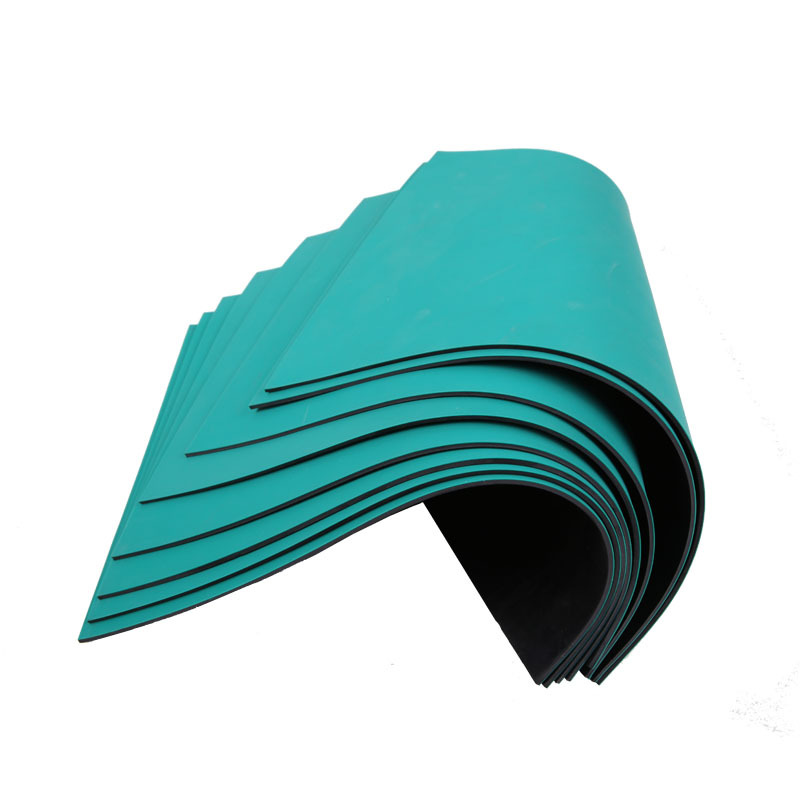
Bulk procurement represents the most efficient strategy for large-scale manufacturing facilities. Purchasing an ESD table mat roll lowers the overall cost per square foot and provides maximum flexibility for outfitting varied station sizes across a massive production floor.
This approach requires managing specific trade-offs. The lower material cost is offset by the internal labor burden required to measure, cut, and install hardware on dozens of stations. Facilities must accurately calculate yield loss—the unavoidable waste generated when cutting specific lengths from a standard 40-foot or 50-foot roll. For example, cutting 6-foot lengths from a 40-foot roll yields six usable sections with 4 feet of scrap. Bulk rolls are best deployed in facilities operating continuous assembly lines that require seamless, long-run coverage, or environments with dedicated maintenance teams capable of executing precise in-house cuts.
Off-the-shelf standard sizes offer rapid deployment for fast-moving operations. Common industry dimensions like 24"x36", 24"x48", and 30"x60" align closely with standard industrial furniture. Purchasing pre-cut materials eliminates internal cutting labor and guarantees perfectly square, factory-finished edges.
The primary trade-off involves potential mismatches with non-standard bench sizes. If a facility utilizes custom-built benches, teardown stations, or older legacy furniture, standard sizes will likely leave unprotected gaps or require awkward positioning. Pre-cut formats deliver the highest value for small to medium operations where immediate deployment, guaranteed aesthetic uniformity, and zero installation labor are prioritized over edge-to-edge custom coverage.
Specialized environments demand exact specifications. Procuring a Custom size ESD mat shifts the burden of precision entirely to the manufacturer. The facility provides exact dimensions, and the manufacturer delivers a product cut to tight tolerances with factory-installed grounding hardware.
While this solution carries a higher upfront cost and longer lead time, it eliminates internal labor and waste. Custom sizing is non-negotiable for complex setups like L-shaped desks, U-shaped testing stations, or benches with integrated equipment cutouts. Furthermore, cleanroom environments heavily favor custom cuts. Cutting materials on-site generates microscopic particulate matter. Factory-cut materials can be cleaned, sealed, and packaged specifically for cleanroom introduction, ensuring precise audit compliance without introducing contamination.
Procurement Format | Best Use Case | Waste Factor (Yield Loss) | Installation Labor Required |
|---|---|---|---|
Bulk Rolls (40ft - 50ft) | Large facilities, continuous assembly lines | High (depends on cut lengths) | High (measuring, cutting, hardware installation) |
Standard Pre-Cut | Standard industrial furniture, rapid deployment | Zero | Low (hardware may be pre-installed) |
Custom Cut | Cleanrooms, L-shaped desks, specialized stations | Zero | Zero (arrives ready to deploy) |
Material composition dictates how a worksurface behaves once sized and installed. An Anti-static rubber table mat typically features a dual-layer construction: a static-dissipative top layer bonded to a conductive bottom layer. This nitrile rubber composition provides exceptional resistance to high heat, harsh chemicals, and direct contact with soldering irons.
The physical weight and rigidity of rubber significantly influence sizing strategies. Heavy rubber lays flat naturally under its own weight. It does not require exact edge-to-edge tension or heavy adhesives to prevent shifting during normal operations. Surface texture also plays a role in large-scale sizing. Smooth rubber is easier to wipe down across expansive benches, while lightly embossed textures reduce overhead glare, which becomes a critical ergonomic factor when outfitting massive, brightly lit inspection areas.
Vinyl and PVC materials offer high flexibility and cost-effectiveness for general assembly environments that do not require high heat resistance. These materials are lighter and easier to cut with standard utility knives, simplifying on-site sizing adjustments for maintenance teams.
However, vinyl's flexibility makes it highly susceptible to edge curling if improperly sized. If a vinyl surface is cut too large and hangs over a bench edge, it will permanently deform much faster than rubber. Vinyl also reacts poorly to localized heat sources. Placing hot equipment on a tightly sized vinyl surface can cause the material to warp, altering its physical dimensions and pulling grounding snaps out of alignment.
Executing cuts on the production floor introduces significant risk. Non-linear cuts create aesthetic issues, uneven edges, and physical snag points for operators. A jagged edge is more likely to fray or catch on clothing, leading to premature material failure and generating particulate contamination.
Mitigate these risks by standardizing the cutting process. Never use standard office scissors or dull blades. Equip maintenance teams with heavy-duty utility knives, fresh blades, and heavy metal straight edges. For large-scale rollouts, invest in specialized industrial shears designed specifically for dense rubber. Always cut on a sacrificial surface, applying firm, continuous pressure to slice through both layers in a single pass, ensuring a clean, square edge that minimizes yield loss.
Covering extra-long assembly lines or uniquely shaped benches often requires joining multiple sections of material. A single roll may not suffice, forcing facilities to manage seams. Poorly managed seams create dead zones where static can discharge improperly.
To mitigate seam failures, properly butt the edges together. Never overlap static control materials. Overlapping creates a physical tripping hazard for components and disrupts the uniform resistance path. Ensure that each independent section maintains its own reliable path-to-ground. Do not rely on physical contact between two separate pieces of material to transfer the ground connection; install dedicated grounding snaps and cords for every individual section.
The method used to secure the material to the bench directly impacts sizing tolerances. Using double-sided ESD tape requires strict dimensional tolerances. Once taped down, the material cannot shift, expand, or contract freely. If taped material undergoes thermal expansion, it will bubble and lift off the bench, creating an uneven work surface.
Loose-lay installation is generally preferred for dense rubber materials. Allowing the material to rest freely on the bench accommodates slight environmental expansion and contraction. It also drastically simplifies maintenance. Loose-lay setups allow maintenance teams to easily lift the material for deep cleaning of the benchtop or rapid replacement of damaged sections without scraping cured adhesive off the furniture.
Installing grounding hardware is the final, and often most failure-prone, step of sizing and implementation. Punching holes too close to a freshly cut edge compromises the structural integrity of the material, leading to tears when the grounding cord is tugged by an operator or caught on a passing cart.
Mitigate hardware failures by enforcing strict installation protocols. Standardize the minimum distance from edges—always install snaps at least 1.5 inches inward. Use the correct punch tools matched to the material's thickness. Utilize proper anvil setters to flare the snap hardware evenly. An unevenly set snap will fail to make consistent contact with the conductive inner layer, resulting in an immediate failure during point-to-ground resistance testing.
Measure your exact usable bench space today, subtracting 1/4-inch from all sides to establish the proper edge clearance and prevent overhangs.
Audit your facility's temperature variations and chemical exposure levels to finalize the choice between dual-layer rubber and standard vinyl materials.
Calculate your acceptable yield loss and internal labor capacity to decide between purchasing bulk rolls or ordering pre-cut dimensions.
Standardize your grounding snap installation protocol across all maintenance teams, ensuring hardware is placed 1.5 inches from edges using heavy-duty punches.
A: It only needs to cover the Electrostatic Protected Area (EPA) where sensitive items are actively handled. However, full bench coverage is highly recommended. Covering the entire surface prevents operators from accidentally placing sensitive components out-of-bounds on insulative surfaces and simplifies the overall cleaning and maintenance of the workstation.
A: Standard 0.060" thickness is ideal for general assembly, inspection, and lightweight component handling. If your operations involve heavy equipment repair, mechanical assembly, or require enhanced ergonomic support to reduce operator fatigue, upgrade to thicker profiles ranging from 0.080" to 0.125".
A: Yes, in-house cutting is feasible but requires proper tooling. Vinyl is relatively easy to cut, while dual-layer rubber demands heavy-duty utility knives and metal straight edges. Avoid cutting materials inside cleanrooms, as the cutting process generates microscopic particulate matter that compromises controlled environments.
A: Common industry standard sizes include 24"x36", 24"x48", 30"x60", and 36"x72". These dimensions are designed to fit standard industrial workbenches and assembly stations, allowing for rapid deployment without the need for custom cutting or trimming.
A: Always leave a 1/4-inch to 1/2-inch border between the edge of the material and the edge of the workbench. This clearance prevents the material from overhanging, reduces the risk of fraying from passing traffic, and ensures the surface lays perfectly flat without bowing.
A: Grounding snaps should be installed 1.5 to 2 inches inward from the corner of the material. This placement ensures the structural integrity of the edge is maintained, prevents tearing when cords are pulled, and keeps the hardware out of the primary working zone.