English
Views: 240 Author: Site Editor Publish Time: 2025-11-24 Origin: Site


You need ESD fabric that does more than look “technical” — it must reliably stop electrostatic discharge in electronics manufacturing, medical device assembly, aerospace production, and other sensitive environments. The right choice balances proven effectiveness, comfort for long shifts, compliance with standards, and practical maintenance. Below I walk through how ESD fabric works, what to look for in materials and construction, and sensible tests and care practices that keep garments protective and usable for longer. I’ll keep this practical and grounded in what technicians, supervisors, and procurement teams actually do on the shop floor.
At its core, ESD fabric is about creating a safe path for static to travel away from you and the things you touch. Producers weave conductive threads — often carbon- or metal-based — into a textile substrate so the resulting garment provides a controlled route for electrostatic charge. When you move, friction can build a charge on your body; properly designed ESD clothing routes that charge into the fabric’s conductive network and ultimately to ground, rather than letting it arc into a sensitive circuit.
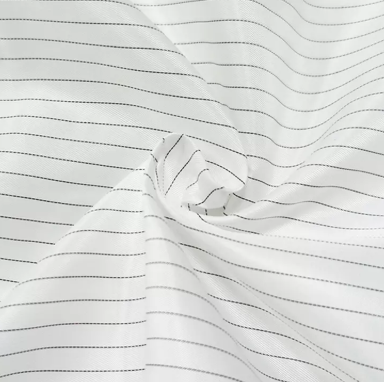
A simple check: garments that really work usually show a faint grid or stripe pattern from the conductive yarns. If you can’t see anything like that, ask for a technical data sheet and surface resistance values before buying.
Think of ESD clothing as a lightweight, wearable Faraday Cage: the conductive network reduces electric field penetration. Worn correctly, the garment forms a partial shield around your body, helping to prevent stray fields or discharges from reaching fragile electronics. It’s not magic — it’s physics and careful textile engineering — but the effect depends on consistent coverage and intact conductive paths.
Manufacturers mix base fibers and conductive yarns in various ways. Materials common in the field include polyester, cotton blends, and nylon, each with trade-offs:
Polyester: tough, dimensionally stable, and holds conductive threads well. A workhorse in high-throughput electronics environments.
Cotton blends: softer and more breathable; often chosen where comfort and prolonged wear are important (medical assembly, labs).
Nylon: offers stretch and mobility — a good pick where flexibility matters (aerospace fit-outs or tasks with a lot of bending).
Effectiveness depends on the conductive grid density and the manufacturing process. Always request the surface resistivity or resistance range (typical target ranges fall between 10⁵ and 10⁹ ohms for many applications) and confirm how those numbers were measured.
| Material | Breathability | Flexibility | Durability | Typical Use |
|---|---|---|---|---|
| Polyester | Medium | Medium | High | Electronics, semiconductor |
| Cotton blend | High | Medium | Medium | Medical, biopharma |
| Nylon | Medium | High | Medium | Aerospace, flexible tasks |
These are broad strokes — check actual garment specs and sample them with your crew before large purchases.
You’ll get better compliance and less misuse when garments are comfortable. Breathability, fit, and freedom of movement matter — workers wearing hot, stiff garments will find ways to roll sleeves up or leave jackets open, defeating protection. Conversely, garments that fit poorly and tug conductive yarns may wear out faster. Balance is key: durable base fibers (polyester) plus comfort-oriented blends often work best for all-day wear.
Standards help you buy clothing that has been tested to industry expectations. Two often-cited ones are:
IEC 61340-5-1 — an international standard covering ESD control for electronic manufacturing.
ANSI/ESD S20.20 — commonly referenced in North America for ESD program requirements.
Check for test reports or certification claims from suppliers, and be skeptical of unsubstantiated marketing buzzwords. Ask for test methods and dates: a garment that passed tests five years ago but has since been reformulated may not meet the same properties today.
Good suppliers add batch codes or serial numbers on labels. Traceability matters for scheduled testing, repairs, and replacement planning. If your facility must audit ESD clothing usage or respond to a contamination incident, traceable garments make the process far easier.
Look for garments with clear conductive patterns or labeled conductive yarns. The grid isn’t cosmetic — its density and continuity matter. A visible pattern also makes quick visual checks easier during inspections.
In cleanrooms and biopharma areas particle shedding is a real issue. Specifications for low lint and low particle release are critical. Likewise, washability matters: garments that lose ESD performance after a few cycles are false economy. Ask suppliers for wash cycle test data (how many cycles before surface resistivity changes) and whether they spec a particular detergent.
Closures that fully seal (zippers covered with flaps, snaps, or ESD-safe Velcro) maintain the Faraday effect. Pockets, seams, and cuff designs should be designed to minimize gaps and keep the conductive layer intact. Fit should be standardised across your team to limit improvisation on the shop floor.
Don’t rely on label claims alone. Regular testing is part of a robust ESD program:
Surface resistance checks: use a calibrated meter to check multiple points — sleeves, chest, seams, and near closures. Typical acceptable ranges depend on your program but often fall between 10⁵ and 10⁹ ohms.
Frequency: test after laundering, or per facility policy; many facilities test at scheduled intervals and random spot checks.
Recordkeeping: log results with garment IDs for traceability.
If a garment’s readings drift, retire or repair it — don’t wait until a failure shows up in product testing.
Maintenance isn’t complicated but it must be consistent:
Wash ESD garments separately in cold or lukewarm water.
Use mild, residue-free detergents formulated for ESD textiles. Avoid brighteners, softeners, and bleach.
Tumble low or air dry — high heat can degrade conductive yarns.
Inspect after each wash for wear, fraying, or pattern fading.
| Care Step | Purpose |
|---|---|
| Gentle wash cycle | Preserve conductive yarns |
| Residue-free detergent | Avoid insulating residues |
| Low heat drying | Prevent fiber degradation |
| Post-wash inspection | Catch wear early |
Order samples and run them through your actual work tasks and wash cycles. Ask line technicians to wear test units for a week and collect feedback on fit, comfort, and functionality. That real-world input prevents expensive mistakes.
Make wearing and maintenance rules simple, visible, and repeatable. Little reminders — a checklist by lockers or a laminated quick-fit guide — reduce common mistakes like rolled sleeves or leaving zippers open. Include garment testing and care in onboarding so new staff follow the same routine from day one.
Track usage cycles per garment using the traceable label system. Decide in advance when a garment will be retired (for example after X wash cycles or after specified reading drift) so replacement becomes planned rather than reactive.
Which industries rely on ESD fabric?
Electronics manufacturing, semiconductor fabs, medical device assembly, biopharma, and aerospace commonly use ESD garments wherever static can damage components.
How do I know a garment is still effective?
Test it with a surface resistance meter, inspect visually after washing, and check for continuity of conductive grids. If resistance is outside acceptable range or the grid shows wear, replace it.
Can I wash ESD fabric with regular laundry?
No — wash separately with a mild, residue-free detergent and avoid fabric softener and bleach.
What standards should I require?
Ask for IEC 61340-5-1 compliance and alignment with ANSI/ESD S20.20 where applicable; request test reports and measurement methods.
Why do ESD garments show grids or stripes?
Those patterns are the woven conductive yarns — the functional element that creates a continuous path to dissipate charge. Visible grids make inspections and verification easier.
Request surface resistance data and wash cycle durability tests.
Ask for sample garments and run a field trial with technicians.
Ensure labeling for traceability and batch tracking.
Confirm supplier provides recommended detergent/cleaning procedure.
Build simple training materials: fit checklist, wearing rules, and inspection steps.
Choosing ESD fabric is as much about people and procedures as it is about the textile. Prioritise materials and designs that your workforce will actually wear correctly, and back that up with testing, traceability, and a small routine of care. Do that, and your garments will protect components — and your production schedule — far more reliably.