English

Views: 0 Author: Site Editor Publish Time: 2026-11-04 Origin: Site


Cleanroom wipers are used for jobs that happen every day in a semiconductor factory: wiping down equipment, cleaning wafer carriers, removing liquid spills and preparing surfaces before use. These tasks may be routine, but the cloth used for them is not an ordinary cleaning cloth. It must remove contamination without adding more.
A wiper can leave behind loose fibers, particles or chemical residues. Some fabrics also react poorly to cleaning solvents. These problems are not always visible after wiping, which is why material descriptions alone are not enough when choosing a product for a semiconductor facility.
Polyester, microfiber and nonwoven wipers are common options. Each has its own strengths. Polyester is widely used for general cleaning, microfiber is often chosen for fine particle removal, and nonwoven materials are useful when liquid absorption is the main concern. The differences become clearer when the fabric construction, edge finish and test results are examined.
Leenol supplies a range of cleanroom wipers for industrial and controlled-environment use.
Consider a wafer carrier that has just been cleaned. The surface may look fine, but a few fibers caught around an edge or a small amount of residue left by the cloth can still cause trouble. The same applies to equipment panels and work surfaces close to a process area.
When contamination is found, the source is not always obvious. Operators may have to repeat the cleaning, inspect the equipment and check materials used during the previous maintenance task. Production can be held up while the issue is investigated. Using a suitable wiper from the start helps avoid introducing another possible source of contamination.
Room classification is only part of the picture. ISO 14644-1 defines cleanroom classes according to airborne particle concentration. ISO Class 3, 4 and 5 environments have different particle limits, but these classifications do not tell users how much lint or residue a particular wiper releases.
That information comes from product testing. The Helmke Drum test measures particles released as a wiper moves inside a rotating drum. Liquid Particle Counting measures particles extracted into a liquid. NVR testing looks at non-volatile residue, while ionic extractables testing can identify ionic substances released from the material.
When comparing products, it is worth asking for the actual test report rather than relying on terms such as “lint-free” or “low particle.” The test method and conditions matter, particularly when results from different suppliers are being compared.
The material used in a wiper affects how it handles dust, liquid and surface contamination. The table below gives a general comparison of three widely used types. The cleanroom classes are indicative references only; they should not be treated as guaranteed ratings for every product in that material group.
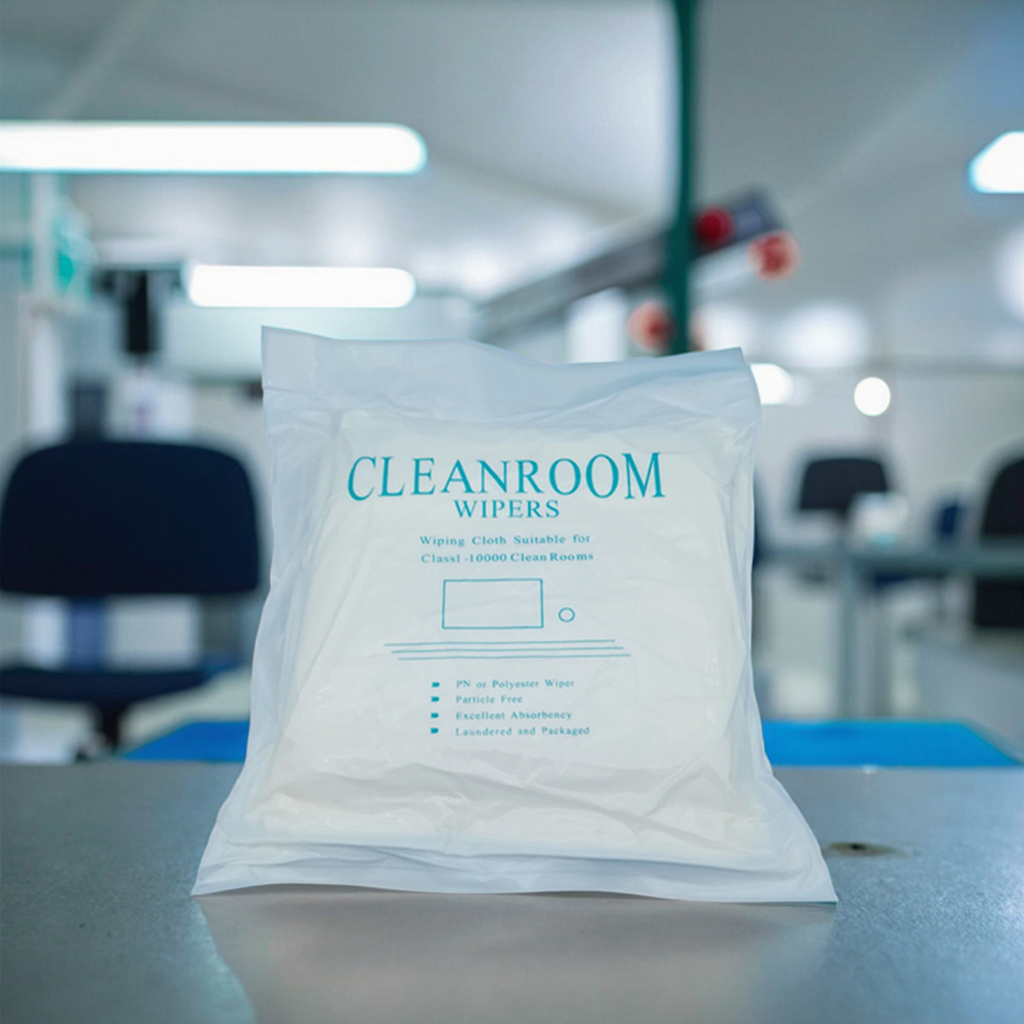
Polyester, microfiber and nonwoven wipers are used for different cleaning requirements.
Wiper Type | Typical Material | Edge Finish | Typical Cleanroom Reference | Common Use |
|---|---|---|---|---|
Knitted Polyester | 100% continuous filament polyester | Laser or ultrasonic sealed | ISO Class 4–5 | Equipment cleaning and solvent application |
Microfiber | 80% polyester / 20% nylon | Laser sealed | ISO Class 3–4 | Fine particle removal and optical cleaning |
Nonwoven Blend | Cellulose and polyester | Cold cut | ISO Class 6–7 | Spill cleanup and outer-fab maintenance |
Actual cleanliness varies from one product to another, even when the basic material is the same. Yarn quality, fabric construction, cutting, laundering and packaging can all affect the result. The finished wiper's test data is more useful than a general material classification.
Knitted polyester is used for many everyday cleaning jobs in semiconductor and electronics facilities. It is commonly made from continuous filament yarn, which helps reduce the loose fibers associated with some staple-fiber fabrics.
A typical specification is 100% polyester with a fabric weight of about 140 g/m². The knitted structure gives the cloth flexibility while retaining enough strength for regular equipment wipe-downs and workstation cleaning.
Polyester is also used with cleaning solvents such as isopropyl alcohol (IPA). It is still sensible to check compatibility with the particular solvent and cleaning procedure. Not every product will behave identically under different concentrations or exposure conditions.
For general cleaning and solvent application, see the LN-1012DLE 100% polyester cleanroom wiper.
Microfiber wipers are commonly produced from polyester and nylon. An 80/20 polyester-to-nylon blend is one example. During production, the fibers are split into finer filaments, giving the cloth a structure that can collect fine dust and oily films from smooth surfaces.
A typical fabric weight is around 160 g/m², although this varies between products. Microfiber is often used on optical components and other surfaces where fine particles or thin surface films are difficult to remove with a conventional cloth.
There is more to check than the fiber size. A microfiber wiper may still release particles or contain extractable residues. For optical cleaning, users should also check whether the cloth leaves streaks or marks on the surface.
Nonwoven wipers are often made from a blend of cellulose and polyester. Unlike knitted fabrics, they are formed by bonding fibers into a sheet. One manufacturing method is hydroentanglement, in which high-pressure water jets help hold the fibers together without chemical binders.
These materials are often selected for their ability to absorb liquid. They are useful for wiping up spills and carrying out general cleaning in areas where the contamination limits are less demanding.
They are not automatically suitable for every semiconductor process. Cellulose content, linting, particle release and extractable residues need attention, especially when the wiper will be used close to exposed wafers. A product intended for general maintenance should not be moved into a more sensitive area without checking its test results.
The edge of a wiper can be a source of loose fibers. Cutting the fabric may leave yarns or filaments exposed, and these can come free during handling or wiping.
Laser sealing uses heat to finish the cut edge. Ultrasonic sealing uses high-frequency vibration to bond the material along the edge. Both methods are used to reduce fiber release from the perimeter of the cloth.
Cold-cut edges are made without the same sealing process. Depending on the fabric, more fibers may remain exposed. Whether this matters depends on the cleaning task and the product's measured performance.
A sealed edge does not make a wiper contamination-free. It addresses fiber release from the cut edge, but the fabric itself may still contain particles or residues. Laundering and packaging also affect the cleanliness of the product supplied to the customer.
One example is the microfiber cleanroom wiper with laser-sealed edges.
The first question is what needs to be removed. A dry particle, an oily deposit and an ionic residue are different problems. The same wiper may not be equally effective against all three.
Microfiber is often used to collect fine dust from smooth surfaces. Its split filaments provide close contact with the surface and help pick up small particles. For use near wafers or sensitive components, check particle-release results for the finished wiper rather than assuming that all microfiber products perform alike.
Oil and grease can spread across a surface if the cloth does not pick them up effectively. Polyester and microfiber are both used for this work. The better choice depends on the type of residue and the cleaning solution being applied.
Solvent compatibility deserves particular attention. A wiper that softens, changes texture or leaves a film during use can make the surface harder to clean. Where the cleaning agent is changed, the material should be checked again.
Some cleaning processes have strict limits for ionic contamination and non-volatile residue. In these applications, the wiper's cleaning and rinsing history is important. Controlled laundering with high-purity water is commonly used to reduce unwanted substances.
Ask for NVR and ionic extractables data when these limits apply. The report should identify the test method, sample preparation and units. A result without this information is difficult to assess, and figures produced by different methods may not be directly comparable.
A supplier's technical data sheet may list particle counts, NVR and ionic extractables. These figures are useful, but only when the test conditions are clear.
For particle testing, check which method was used and how the sample was handled. The Helmke Drum test and Liquid Particle Counting do not measure the same thing, so their results should not be compared as though they were interchangeable. The same care applies to residue testing: extraction liquid, sample size and preparation can affect the reported value.
It is also worth confirming that the tested sample represents the product being purchased. Results from untreated fabric may not reflect a wiper after cutting, edge sealing, laundering and packaging. Those manufacturing steps can change the cleanliness of the finished item.
Dry wipers are a practical choice when the facility uses different cleaning solutions or needs to control the amount applied. Operators add the solution during the cleaning process, following the site's procedure.
Pre-saturated wipers arrive with cleaning liquid already added. Some products use a mixture of 70% IPA and 30% deionized water. Because the solution is prepared in advance, the amount of liquid on each wiper can be more consistent.
The choice depends on the surface, cleaning agent and working procedure. For pre-saturated products, check the solution composition, package seal, shelf life and storage conditions. A product that has dried out or been stored incorrectly may not perform as expected.
Even a well-made wiper can pick up contamination if it is poorly packed or handled. Packaging should protect the cloth during transport and storage and suit the facility's procedure for bringing materials into the cleanroom.
Check whether the wipers are supplied individually or in bulk, how the package is sealed and what instructions apply after opening. Pre-saturated products need particular attention to package integrity and shelf life. Operators should follow the supplier's storage and handling instructions rather than leaving opened packs exposed in the work area.
Knitted polyester, microfiber and nonwoven wipers each serve a different purpose in semiconductor manufacturing. Polyester is commonly used for routine equipment cleaning, microfiber is useful for fine particles and oily films, while nonwoven materials are often chosen for liquid absorption and general maintenance.
Choosing between them means looking at the cleaning task as well as the product specification. Fabric construction, edge treatment, solvent compatibility, laundering and packaging all affect performance. Where contamination limits are tight, test results for the finished wiper should form part of the purchasing decision.
More product details are available in the cleanroom wiper range and the Leenol product catalog.
Microfiber and specially processed polyester wipers are commonly considered for highly controlled environments. The room's ISO classification does not certify the wiper. Check the product's particle-release, NVR and ionic extractables results before using it in an ISO Class 3 area.
The Helmke Drum test measures particles released when a wiper is moved mechanically inside a rotating drum. Liquid Particle Counting measures particles extracted into a liquid. The methods assess different aspects of cleanliness, so the test method should always be stated with the result.
Continuous filament polyester is widely used because its construction can help control fiber release. Cotton contains staple fibers that may shed lint during wiping. Polyester is also compatible with many cleaning procedures used in controlled environments. The final choice should be based on product test data and the requirements of the application.
ISO 14644-1 classifies cleanrooms by airborne particle concentration. ISO Class 3 has lower permitted particle concentrations than ISO Class 5. The classification describes the room's air cleanliness, not the amount of contamination a particular wiper may release.
Yes. They are often used for spill cleanup and general maintenance in areas with less demanding contamination limits. For work close to exposed wafers or sensitive process equipment, check the specific product's particle and extractable results first.
Laser and ultrasonic sealing reduce loose fibers along the cut edge. They can help control one source of particle contamination, but they do not guarantee that the entire wiper is free from particles or chemical residues. Fabric quality and the cleaning and packaging processes matter as well.
Dry wipers allow operators to use the cleaning solution specified for their process. Pre-saturated wipers arrive with a prepared solution and can make liquid application more consistent. The suitable option depends on the cleaning agent, surface and handling procedure.