English
Views: 286 Author: Site Editor Publish Time: 2026-03-27 Origin: Site


In electronics manufacturing, the biggest threats are often the ones you can’t see.
Electrostatic discharge (ESD) is one of them. It doesn’t always produce sparks. It doesn’t make noise. And in many cases, it doesn’t cause immediate failure. But over time, it quietly damages components, reduces product lifespan, and creates inconsistencies that are incredibly difficult to trace.
What makes it more problematic is that static electricity is unavoidable. It’s generated through everyday actions—walking, handling materials, even just moving your arms.
Now imagine that happening in a production line where microchips are being assembled. Even a small discharge—far below what a human can feel—can degrade or destroy sensitive circuits.
This is exactly why ESD protection exists. And at the center of that protection system is something that might look surprisingly simple: ESD fabric.
But don’t let its appearance fool you. ESD fabric is not just a textile—it’s a carefully engineered material designed to control one of the most unpredictable forces in industrial environments.

ESD fabric, or Electrostatic Discharge fabric, is a specialized textile designed to prevent the buildup of static electricity and safely dissipate electrical charges before they can cause damage.
At first glance, it behaves like any other fabric. It’s flexible, wearable, and comfortable. But internally, it works very differently.
Ordinary fabrics—especially synthetic ones—tend to accumulate static charges when they rub against other materials. These charges stay trapped on the surface until they suddenly discharge. That discharge is what damages electronics.
ESD fabric changes this behavior completely.
Instead of allowing charge to accumulate, it creates a controlled pathway for electricity to move and dissipate gradually, preventing sudden discharge events.
In simple terms:
Normal fabric = stores static
ESD fabric = releases static safely
That one difference is what makes it indispensable in modern industry.
To really understand the value of ESD fabric, you need to understand the scale of the problem it solves.
Electrostatic discharge is defined as the sudden flow of electricity between two objects with different charges.
That sounds harmless—until you look at the numbers.
A person walking across a floor can generate thousands of volts of static electricity. Yet many electronic components can be damaged by less than 100 volts.
That means damage can happen without any visible sign.
What makes ESD especially problematic is that it doesn’t always cause immediate failure.
There are generally two types of damage:
Catastrophic damage: the component fails instantly
Latent damage: the component appears fine but degrades over time
Latent damage is actually more dangerous in many cases. It leads to:
Unexpected product failure
Warranty issues
Reduced reliability
And because the damage happens earlier in the process, it’s often impossible to trace back.
Interestingly, the biggest source of static in most environments is not machines—it’s people.
Human movement constantly generates static through friction. Clothing, especially synthetic materials, makes this worse. Without proper control, a worker can unintentionally discharge electricity directly onto a sensitive component.
This is why ESD protection systems focus heavily on garments and materials, not just equipment.
This is where things get interesting.
ESD fabric doesn’t “block” electricity. Instead, it manages how electricity behaves.
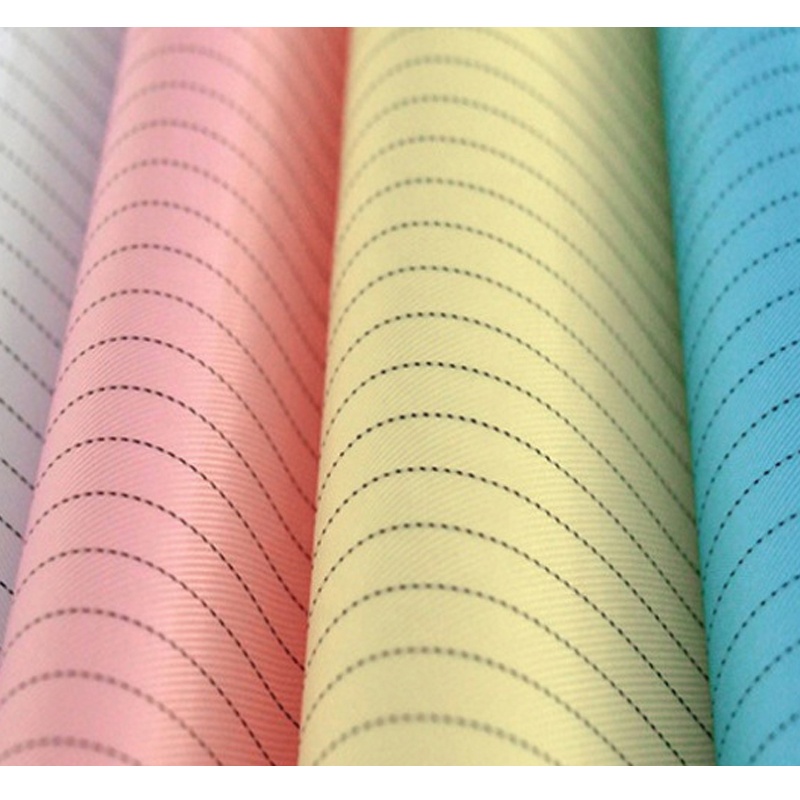
At the core of ESD fabric is the integration of conductive fibers into the textile structure.
These fibers—often made of carbon or metal-based materials—are woven or embedded into the fabric in a controlled pattern.
Their role is simple but powerful:
They create a network that allows electrical charges to move across the fabric instead of staying trapped.
This means that whenever static is generated, it doesn’t accumulate—it spreads out and dissipates safely.
This distinction is critical.
Static electricity becomes dangerous when it discharges suddenly. ESD fabric prevents this by ensuring that:
Charges are released gradually
Voltage does not build up
No sudden energy spike occurs
In technical terms, ESD fabrics operate in a static dissipative range, which balances conductivity and resistance.
Too conductive would create sparks.
Too insulating would allow buildup.
ESD fabric sits right in the middle—where it can safely control charge behavior.
In many ESD garments, especially those with grid patterns, the fabric forms what is known as a Faraday cage effect.
This means the conductive network surrounds the body and:
Shields internal and external electric fields
Distributes charge evenly
Prevents localized discharge
This is one of the reasons why you often see grid or stripe patterns in ESD clothing—they are functional, not decorative.
In many environments, ESD fabric works together with grounding systems.
The fabric dissipates the charge, but grounding ensures that the charge is ultimately transferred away from the system.
Without grounding, charges can still accumulate over time. That’s why ESD control is usually a complete system, not just a material choice.
Not all ESD fabrics are created equal. The differences are not just technical—they directly affect performance, durability, and cost.
This is the most widely used and preferred type in industrial environments.
In this approach, conductive fibers are permanently woven into the fabric. That means the anti-static function is built into the structure itself—not applied later.
The advantage is long-term stability. Even after repeated washing or heavy use, the fabric maintains its performance.
This is why most high-end ESD garments use this method.
Some fabrics rely on chemical coatings to provide anti-static properties.
These are typically:
Lower cost
Easier to produce
However, the downside is durability. The coating can wear off over time, especially with washing or exposure to harsh environments.
These fabrics are generally used in less critical applications.
If you’ve ever noticed ESD garments with visible patterns, that’s not a design choice—it’s engineering.
Conductive fibers are arranged in:
Grid patterns
Parallel stripes
This ensures uniform conductivity across the entire fabric, reducing weak points and improving reliability.
It also enhances the Faraday cage effect, making these fabrics ideal for sensitive environments.

Now that we understand how it works, let’s look at what it actually delivers in practice.
The most obvious benefit is preventing damage.
ESD fabric ensures that static charges never reach levels that could harm electronic components. This is particularly important in industries where even microscopic circuits can be affected.
Static electricity attracts dust and particles.
In cleanroom environments, this creates a double problem:
Static damages components
Dust causes contamination
ESD fabrics reduce both by minimizing static buildup, which directly improves product quality.
In industries like petrochemicals, static discharge can cause fires or explosions.
ESD fabrics reduce this risk by preventing sparks and controlling charge buildup, making them a key part of safety systems.
One of the less obvious benefits is consistency.
When static is controlled:
Processes become more predictable
Defect rates decrease
Production efficiency improves
This is why ESD control is often considered a quality control measure, not just a safety feature.
Choosing ESD fabric doesn’t have to be overly technical—but it does require understanding your environment.
Ask practical questions:
Are you working in a cleanroom?
How sensitive are the components?
Is there a risk of explosion or contamination?
These factors determine the level of protection required.
Many buyers focus only on resistance values.
But what really matters is:
Long-term stability
Resistance to washing
Consistency across environments
Fabrics with embedded conductive fibers are usually the safest choice.
Especially for garments, comfort matters more than people think.
If workers are uncomfortable, they may not wear the clothing properly—reducing effectiveness.
A good ESD fabric should offer:
Breathability
Flexibility
Durability
As technology evolves, the margin for error is shrinking.
Modern electronics are:
Smaller
More complex
More sensitive
At the same time:
Production speeds are increasing
Cleanroom standards are getting stricter
This means ESD control is no longer optional—it’s foundational to manufacturing success.
In real industrial environments, companies don’t just need materials—they need reliable systems.
LEENOL, as an ESD Total Solution provider, offers high-quality ESD fabrics designed for stable performance in demanding conditions.
What sets LEENOL apart is its focus on consistency and real-world usability:
Stable surface resistance (10⁴–10⁹ range)
Conductive fiber blending for long-term durability
Performance unaffected by humidity or temperature
Customizable solutions for different industries and applications
Combined with its broader product ecosystem—covering cleanroom, storage, and ESD protection—LEENOL helps businesses build a complete and reliable static control system, not just solve isolated issues.
ESD fabric is used to prevent static buildup and protect sensitive electronics from electrostatic discharge during manufacturing, handling, and storage.
It dissipates electrical charges through conductive fibers, preventing sudden discharge that could damage components.
Anti-static fabric reduces static buildup, while ESD fabric actively controls and safely dissipates electrical charges.
Yes. High-quality ESD fabrics retain performance after repeated washing, especially those with embedded conductive fibers.
Because even small static discharges can damage components, reduce product quality, and increase production costs.