English
Views: 226 Author: Site Editor Publish Time: 2026-05-06 Origin: Site


If you have ever searched for ESD fabric online, you have probably seen two terms come up again and again: conductive fabric and anti static fabric. At first glance, they seem almost interchangeable. A lot of suppliers use them side by side, and some product pages even mix the two without explaining what makes them different. That is exactly why many buyers get stuck at the beginning. They know they need fabric for static control, but they are not fully sure which type actually fits their application.
To be honest, the confusion is understandable. Both conductive fabric and anti static fabric are related to electrostatic protection. Both are used in industries where static electricity can create problems. Both may appear in workwear, cleanroom garments, protective clothing, and technical textile products. But once you move beyond the surface, the difference starts to matter. These two materials are related, yes, but they are not identical in purpose, structure, or emphasis.
And this is not just a technical wording issue. In real production environments, choosing the wrong fabric can affect garment performance, safety, product quality, and even cost over time. In electronics manufacturing, static discharge can damage sensitive components. In chemical or petroleum environments, static buildup can create a safety risk. In cleanrooms, poor fabric selection may influence contamination control or long-term garment reliability. So when people ask about the difference between conductive and anti static fabric, they are usually asking a much more practical question underneath: which one should I actually use?
That is what this article is here to answer. We will look at what conductive fabric really is, what anti static fabric means in practical terms, where they overlap, where they differ, and how to choose the right ESD fabric for actual industrial use. No overcomplication, no vague marketing language—just a clear breakdown that makes the decision easier.
The main reason people mix these two together is simple: they are both used to control static electricity. In many applications, they even appear in similar products, especially protective garments, uniforms, and cleanroom apparel. So from a buyer’s point of view, the distinction is not always obvious right away.
Another reason is that suppliers sometimes describe a fabric from different angles. One supplier may call a material conductive because it contains conductive fibers. Another may describe the same type of material as anti static because its purpose is to reduce charge buildup during wear. In that sense, the same fabric can sit in both conversations, depending on whether the focus is on material structure or end-use function.
Still, that does not mean the terms are completely identical. It is better to think of them as closely connected, but not equal. Conductive fabric usually emphasizes the fabric’s ability to transfer or conduct charge through built-in conductive elements. Anti static fabric usually emphasizes the prevention and dissipation of static electricity so that charge does not accumulate to a dangerous or disruptive level.
That distinction may sound small, but in sourcing and application, it changes how people evaluate the material.
Conductive fabric is a textile that contains conductive components capable of carrying electrical charge more effectively than ordinary fabric. These conductive elements may be introduced through conductive yarns, conductive fibers, metal-containing filaments, carbon-based materials, or similar structures built into the fabric.
In plain terms, conductive fabric provides a route for charge to move. Instead of allowing electricity to stay trapped on the surface of the textile, the fabric helps transfer it. That is why conductive materials are often discussed in relation to electrostatic discharge control, electromagnetic shielding, and specialized technical protection.
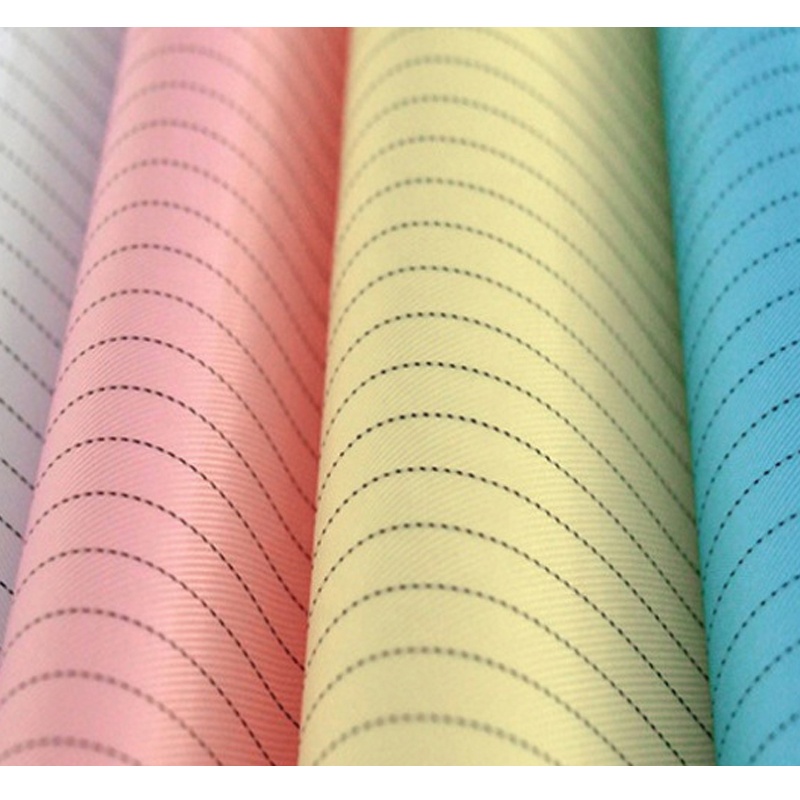
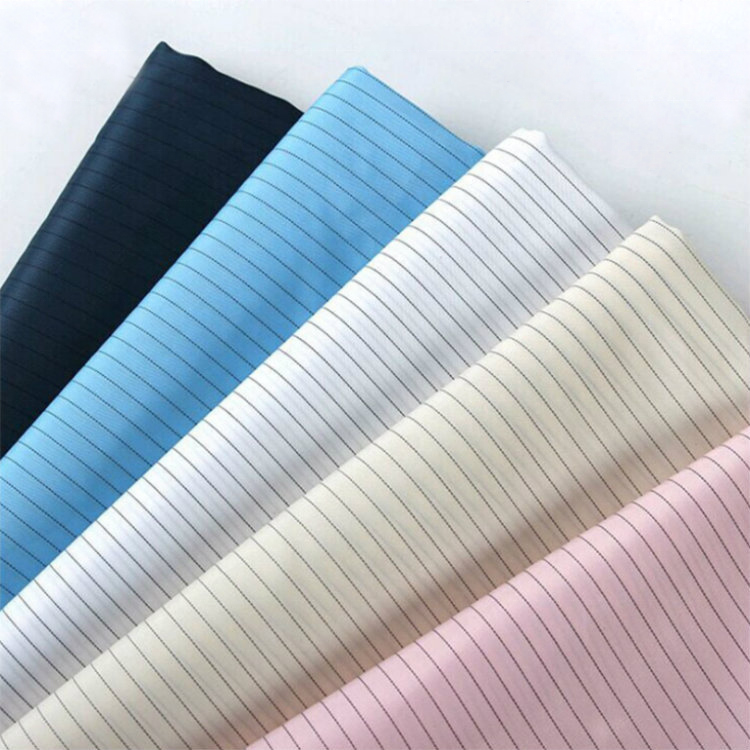
In many industrial fabrics, conductivity is achieved by blending conductive fibers directly into the textile. This is one of the more reliable approaches because the conductive function becomes part of the fabric itself rather than just a temporary surface feature. You will often see this reflected in stripe or grid patterns, especially in technical workwear and cleanroom garments.
The working idea behind conductive fabric is fairly straightforward. Once conductive fibers are integrated into the textile, they create a continuous or semi-continuous pathway for charge transfer. This allows electrical energy to move away instead of building up in one place.
That matters because static electricity tends to build through friction, movement, and repeated contact. Workers walking, sitting, reaching, or handling materials can generate charge constantly. If the garment fabric can guide that charge away rather than letting it accumulate, the risk level goes down.
In some applications, conductive fabric also helps with electromagnetic shielding. Certain polyester conductive fabrics, for example, are described as being able to reflect or absorb electromagnetic waves while also offering electrostatic protection. That makes them useful in more technically demanding environments.
Conductive fabric is often used where the textile itself needs a more engineered role. This includes electronics-related environments, technical garments, shielding-related applications, and industrial workwear designed for stable electrostatic control. It may also appear in specialty sewing materials such as conductive thread, which helps maintain the protective performance of the final garment system.
So while conductive fabric is not always the everyday language used by all buyers, it is definitely an important category in professional static-control textiles.
Anti static fabric is a functional textile made to reduce the buildup of static electricity and help dissipate charges in a safer, more controlled way. Its job is not necessarily to “conduct electricity” in the broad technical sense, but rather to stop charge from accumulating to the point where it causes trouble.
That trouble can take different forms. In some industries, it means sparks. In others, it means dust attraction, interference with production, discomfort for workers, or damage to sensitive electronic components. Anti static fabric is designed to reduce those risks during regular use.
This kind of fabric may be produced in different ways. Common methods include adding anti static finishing agents, modifying fibers chemically, or blending conductive fibers into the textile structure. Among these approaches, conductive-fiber blending is usually seen as the more durable option, since the anti static function is built into the fabric rather than only applied to the surface.
One thing worth pointing out is that anti static fabric is very often discussed from the perspective of actual garments. In other words, it is not just about the textile in isolation. It is about what happens when that textile becomes a coat, a coverall, a cleanroom suit, or a work uniform.
That is why anti static fabric is such a common term in industries like electronics, petroleum, mining, chemical processing, medicine, aerospace, and clean manufacturing. Buyers in these fields are usually not looking for theoretical conductivity. They are looking for clothing materials that work reliably on the job.
When someone buys anti static fabric, they usually expect several things at once. They want stable electrostatic performance. They want durability. They often want washability. They may also need comfort, color consistency, and garment compatibility. In many cases, they are not buying fabric as a lab sample—they are buying fabric that will be cut, sewn, washed, worn, and used repeatedly in a real environment.
That is why the better anti static fabrics tend to be the ones that combine function with wearability. The material has to perform, but it also has to behave like a textile people can actually work in.
Now to the key question.
The clearest way to put it is this: conductive fabric describes a fabric in terms of how it is built and how it transfers charge, while anti static fabric describes a fabric in terms of what it is meant to prevent—namely, the buildup of static electricity.
So conductive fabric is more about the mechanism. Anti static fabric is more about the function in use.
That is why the two often overlap. A fabric that contains conductive fibers may also be sold as anti static fabric because those fibers help dissipate charge. But not every anti static fabric is described primarily as a conductive textile. Some are marketed based on garment application rather than textile engineering language.
Conductive fabric usually highlights conductivity itself. The attention is on charge transfer, conductive pathways, or sometimes shielding capacity. Anti static fabric highlights static control in daily use. The attention is on reducing buildup, improving safety, and protecting products or people from electrostatic problems.
This is why a technical textile engineer and a garment buyer may talk about the same fabric differently. One sees the structure. The other sees the job it needs to do.
In the market, anti static fabric is the more common phrase when the product is intended for uniforms, coats, coveralls, or workwear. Conductive fabric sounds more technical and is often used when the supplier wants to emphasize the material construction, higher-end protection, or added features such as electromagnetic shielding.
Neither term is wrong. They simply come from a different angle.
People looking for conductive fabric are often asking, “What is inside this textile, and how does it behave?” People looking for anti static fabric are often asking, “Will this fabric help stop static problems in my workplace?” Those are not exactly the same question, even if they lead to similar products.
If there is one point that really connects conductive fabric and anti static fabric, it is the role of conductive fiber. In many high-quality ESD fabric products, conductive fiber is what makes reliable anti static performance possible.
This is important because not all anti static effects last the same way. Some lower-level materials rely heavily on surface treatment. That can work to some extent, but surface treatments may weaken after washing, abrasion, or long-term use. When conductive fibers are actually woven or blended into the textile, the performance tends to be more stable.
That is one reason why conductive-fiber blending is often considered the mainstream technology in durable anti static textile manufacturing. It gives the fabric a built-in electrostatic function instead of a temporary one.
For industrial garments, durability is not optional. Fabrics are washed, worn, folded, stretched, and exposed to daily friction. If the anti static function drops off too quickly, the garment stops doing the job it was purchased for.
Integrated conductive fiber helps reduce that risk. The fabric is more likely to maintain stable performance over time, which is exactly what serious buyers want from professional ESD workwear materials.
Another reason conductive fiber is valued is performance stability. Some anti static fabrics are specifically promoted as being less affected by changes in humidity, temperature, and environment. That matters because real workplaces are not always perfectly controlled. A fabric may need to perform in changing seasonal conditions, different production zones, or mixed-use facilities.
Reliable ESD fabric has to work outside ideal test conditions. That is where material structure becomes more than a technical detail—it becomes a real purchasing decision.
To make the difference more practical, it helps to look at real product categories. Buyers rarely choose between abstract terms alone. They choose between actual fabrics with specific structures and compositions.
TC ESD fabric is typically a polyester-cotton blend with conductive fiber added in. It is often used for anti static workwear because it balances comfort, durability, and protective function. A representative example is a TC fabric with 63% polyester, 33% cotton, and 4% conductive fiber, with surface resistance in the range of 106 to 109 ohms.
This type of fabric is usually attractive for industrial uniforms because it feels more practical for daily wear while still offering stable anti static performance. It is a good example of how anti static fabric is often developed with garment use in mind.
Stripe-pattern polyester ESD fabric usually contains conductive fibers arranged in straight intervals. One typical construction uses 99% polyester and 1% conductive fiber, again with surface resistance around 106 to 109 ohms. This kind of fabric is often presented as a material for electrostatic protection and, in some cases, electromagnetic shielding.
Because the conductive pattern is visible, stripe fabrics often look more technical. They are commonly used in anti static garments for electronics, industrial production, and other static-sensitive work environments.
Grid ESD fabric uses conductive fibers in a cross-grid structure. A typical example may use 98% polyester and 2% conductive fiber, with surface resistance in the range of 105 to 107 ohms. This construction is often associated with cleaner, more uniform anti static garments and is widely used in workwear and cleanroom-related applications.
Grid fabrics are a good example of how a conductive structure is used to create anti static function in a garment-friendly textile.
It is also worth mentioning that fabric alone is not the whole story. Sewing thread matters too. Conductive sewing thread can help support the anti static performance of the garment as a complete system. If the fabric is carefully selected but the sewing materials are poorly matched, the final result may not perform as intended.
There is no one-size-fits-all answer, but for most industrial clothing applications, anti static fabric with built-in conductive fibers is the practical choice. That is because it gives buyers the performance they need in a form that suits real garments: washable, durable, wearable, and relatively easy to process into uniforms or protective clothing.
Conductive fabric becomes especially relevant when the application asks for something more technical, such as stronger conductivity emphasis, shielding support, or a more engineered material function. In those cases, the buyer may care more about the conductive structure itself.
If the goal is to produce anti static clothing for electronics factories, laboratories, petroleum workshops, chemical processing, or similar working environments, then anti static fabric is usually the more natural category to focus on. It is closer to how the garment will actually be used.
If the application involves stronger concern about conductivity pathways, technical shielding, or more specialized protective textile behavior, then conductive fabric may be the better description and perhaps the better choice as well.
So the better question is not “Which is better overall?” but “Which is better for the job I need the fabric to do?”

Choosing the right ESD fabric takes a bit more than checking a label. A smart buyer usually looks at the full picture.
Start with where the garment will be used. A cleanroom, electronics assembly area, petrochemical site, or food processing facility may all need static-control clothing, but the priorities are not always the same. Some environments care more about garment cleanliness, some about spark prevention, some about electronics safety, and some about all of them together.
Look at what the fabric is actually made from. Polyester, cotton blends, conductive fiber percentage, and structural pattern all influence performance. The composition often tells you more than the product title.
Surface resistance is one of the most practical technical indicators in anti static textiles. It gives buyers a way to compare products and understand the range of performance expected in use.
Some fabrics look fine on paper but lose value if they cannot hold up after repeated laundering. For workwear, long-term durability is critical. If the static-control performance fades too quickly, replacement costs go up and protection goes down.
Color, pattern, sewing compatibility, comfort, and customization all matter, especially for larger buyers or uniform projects. A technically sound fabric still needs to fit the actual clothing program.
There are a few mistakes that show up pretty often when people source anti static textiles.
Not all anti static fabrics are built the same way. Some rely more on finishing, while others use conductive fiber blending. The difference affects durability and long-term reliability.
A lower price may look attractive at the beginning, but if the fabric wears out quickly or loses performance after washing, the total cost is not really lower. In professional applications, poor fabric choice usually becomes expensive later.
Fabric is important, but so are sewing thread, garment design, and construction details. Good ESD clothing depends on the whole system working together.
It is easy to focus too much on names like conductive or anti static. In practice, buyers should also check composition, pattern, resistance values, washability, and application recommendations. The spec sheet often tells the real story.

So, what is the difference between conductive fabric and anti static fabric? The simplest answer is that conductive fabric focuses more on the fabric’s built-in ability to transfer charge, while anti static fabric focuses more on preventing static buildup and making garments safer and more reliable in everyday industrial use. The two are closely connected, and in many cases, good anti static fabric depends on conductive elements to do its job well.
For most buyers, the smartest approach is not to get too stuck on the wording. Instead, pay attention to how the fabric is constructed, whether conductive fibers are built in, how stable the performance is, whether the material is washable, and how well it matches your actual application. That is what really determines whether an ESD fabric works in production, not just in product descriptions.
For companies sourcing professional anti static textile solutions, LEENOL offers a broad range of ESD fabric products designed for static control and equipment protection, including TC anti static fabric, 5mm strip polyester fabric, 5mm grid polyester fabric, conductive sewing materials, and other customizable options. As an ESD TOTAL SOLUTION supplier serving factories and laboratories, LEENOL focuses on practical product quality, stable anti static performance, and flexible support for customers who need reliable fabric solutions for protective clothing and static-sensitive environments.
Not always, but conductive fabric is often used to achieve anti static performance. Conductive fabric focuses on charge transfer, while anti static fabric focuses on reducing static buildup in actual use.
ESD fabric is mainly used for anti static clothing, cleanroom garments, electronics manufacturing apparel, and workwear for industries where static electricity can affect safety, equipment, or product quality.
Both can work well. The better choice depends on the application, garment design, and performance requirements. Grid and stripe fabrics are both common in anti static clothing.
Conductive fibers help create a more stable and durable way to dissipate charge. Because they are built into the textile structure, they usually offer better long-term performance than temporary surface treatments alone.
Look for a supplier that can provide clear specifications, stable quality, application-based recommendations, and customization support. Good suppliers do more than sell fabric—they help match the right material to the right working environment.