English
Views: 169 Author: Site Editor Publish Time: 2026-06-03 Origin: Site


When people hear the word “cleanroom,” they usually imagine a perfectly controlled environment with spotless floors, purified air, and zero contamination. On the surface, many cleanrooms do appear exceptionally clean. Workers wear protective garments, air filtration systems run continuously, and cleaning schedules are strictly followed.
But the reality inside many facilities is often more complicated.
Even highly controlled environments can quietly accumulate contamination throughout the day. Dust particles enter through shoes, cart wheels, packaging materials, door openings, and even human movement itself. In some cases, contamination levels rise slowly enough that facilities do not notice the problem until product defects, failed inspections, or equipment issues begin appearing.
This hidden contamination is exactly why Sticky Mat systems remain one of the most important and widely used tools in cleanroom contamination control.
Although sticky mats are simple in design, they help stop dust at one of its biggest entry points: foot traffic and mobile equipment. When used properly, they can significantly reduce contamination transfer, improve cleanliness stability, and support better product quality across a wide range of industries.
In this article, we’ll take a closer look at why cleanrooms are often dirtier than expected, where hidden contamination comes from, and how sticky mats help facilities maintain cleaner and safer controlled environments.
Many companies invest heavily in air filtration systems, cleanroom garments, and environmental monitoring. While these systems are essential, contamination still finds ways into controlled areas every single day.
One reason is simple: cleanrooms are not completely isolated environments. Employees constantly move in and out. Materials are transported between departments. Equipment gets rolled across floors. Packaging enters from warehouses. Doors open and close throughout operations.
Every one of these activities introduces particles into the environment.
What makes contamination particularly challenging is that many particles are microscopic. A cleanroom floor may look perfectly clean to the human eye while still containing thousands of invisible particles capable of affecting sensitive manufacturing processes.
In electronics production, a tiny dust particle can damage a microchip or interfere with circuit assembly. In pharmaceutical environments, contamination may compromise sterile production conditions. In laboratories, airborne particles can interfere with testing accuracy and research reliability.
The cleaner the process requirements become, the more dangerous small contamination sources can be.
People are one of the largest contamination sources inside controlled environments.
Every time someone walks into a cleanroom, particles from shoes and clothing can enter with them. Even employees following gowning procedures may still carry fine dust and debris from surrounding areas.
Studies have shown that foot traffic contributes significantly to particle transfer into sensitive environments, especially near entrances and transition zones.
Many facilities focus heavily on footwear contamination but underestimate how much dirt enters through wheels.
Trolleys, carts, pallet jacks, and movable equipment travel between warehouses, hallways, production rooms, and loading areas throughout the day. Wheels collect dust easily and spread contamination across floors as they move through the facility.
Without proper contamination control at entry points, wheel traffic can quickly spread particles throughout large areas.
Cardboard boxes, plastic wrapping, pallets, and shipping materials frequently carry particles from storage or transportation environments.
When these materials enter controlled spaces, they can release fibers and dust into the surrounding air.
Even advanced HVAC and filtration systems cannot instantly eliminate every airborne particle.
As employees move around or equipment operates, settled dust becomes airborne again and continues circulating inside the cleanroom.
This means floor contamination eventually becomes air contamination as well.

Outside industrial environments, dust is mostly viewed as a housekeeping issue. Inside cleanrooms, it becomes a quality-control issue.
In precision manufacturing industries, microscopic contamination can lead to:
Damaged electronic components
Coating imperfections
Assembly failures
Optical defects
Sterile packaging contamination
Reduced production yield
Sometimes the cost of a single contaminated batch can far exceed the investment required for preventative contamination-control measures.
Dust buildup affects machinery performance over time.
Particles can block ventilation systems, interfere with sensors, reduce equipment precision, and increase maintenance frequency. Sensitive instruments often perform less accurately in unstable contamination environments.
The more contamination enters a cleanroom, the harder facility teams must work to maintain standards.
Excessive dust increases:
Cleaning labor
Downtime for maintenance
Cleaning chemical usage
Air filter replacement frequency
Operational interruptions
This is why contamination prevention is usually far more cost-effective than contamination removal.
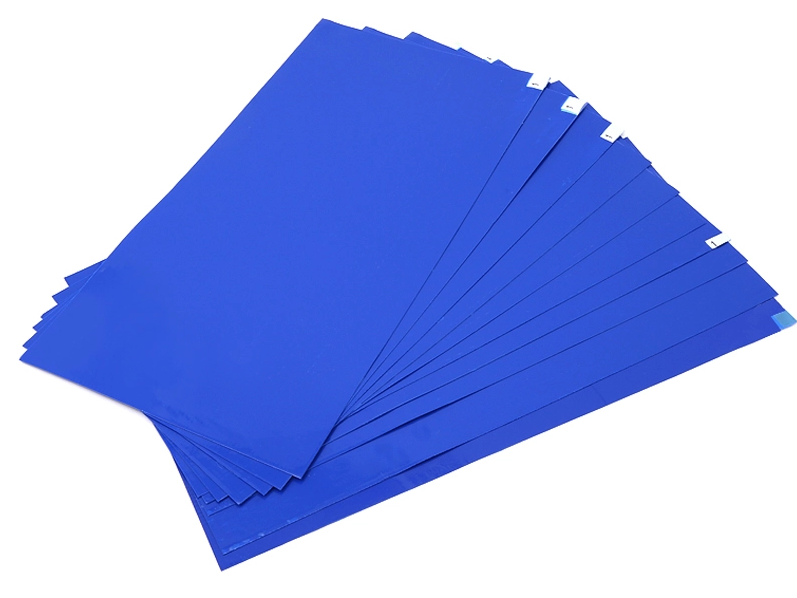
A Sticky Mat is a multi-layer adhesive floor mat designed to capture dirt, dust, and debris from footwear and wheeled equipment before contaminants enter controlled environments.
Sticky mats are commonly installed at:
Cleanroom entrances
Air shower exits
Laboratory access points
Hospital operating rooms
Electronics manufacturing areas
Pharmaceutical production zones
Packaging rooms
Each layer of the mat contains a pressure-sensitive adhesive coating that traps particles upon contact. Once the top layer becomes dirty, operators simply peel it away to expose a fresh clean layer underneath.
Although the concept is simple, sticky mats provide highly effective contamination reduction at one of the most critical control points in any facility: the entrance.
One of the smartest ways to control contamination is preventing it from entering the cleanroom in the first place.
Sticky mats work as an immediate capture point for particles attached to shoes and wheels. Instead of allowing contaminants to spread deeper into controlled areas, the adhesive surface traps them at the entrance.
This greatly reduces particle movement throughout the facility.
Floor contamination does not stay on the floor forever.
As people walk or equipment moves, particles become airborne and circulate throughout the environment. By removing particles early, sticky mats help reduce the amount of contamination that later enters the air system.
This contributes to more stable cleanliness conditions inside the cleanroom.
Cleanroom performance is not just about achieving cleanliness once — it is about maintaining consistent environmental stability over time.
Sticky mats help reduce contamination fluctuations caused by daily operational movement, making it easier for facilities to maintain target cleanliness levels.
Interestingly, sticky mats also create psychological awareness around contamination control.
When employees step onto contamination-control surfaces before entering clean areas, it reinforces the importance of maintaining proper cleanroom procedures and hygiene practices.

Traditional sticky mats are usually manufactured from polyethylene (PE) film with multiple disposable adhesive layers.
Advantages include:
Easy maintenance
Fast layer replacement
Cost-effective operation
Strong dust-removal performance
Wide industry compatibility
These mats are widely used in electronics, pharmaceuticals, and industrial cleanrooms.
Washable sticky mats use polyurethane (PU) materials designed for repeated cleaning and long-term reuse.
Benefits include:
Long service life
Reduced waste generation
Environmentally friendly operation
Stable adhesive performance
Many facilities now use washable mats as part of sustainability initiatives and environmental management programs.
Sticky mats should always be installed directly where contamination enters the controlled environment.
Common installation areas include:
Main cleanroom entrances
Gowning room exits
Warehouse-to-production transitions
Material transfer zones
Airlock entry points
A larger mat allows multiple foot contacts before entry, increasing dust-removal effectiveness.
Facilities should select mat sizes based on traffic volume and entrance dimensions.
A sticky mat loses effectiveness when the surface becomes overloaded with particles.
Regular layer replacement ensures continuous contamination-control performance.
Employees should understand why sticky mats are important and avoid bypassing them during busy operations.
Even the best contamination-control products depend on proper usage habits.
Modern cleanrooms are becoming increasingly advanced, especially in industries such as semiconductor manufacturing, biotechnology, aerospace, and precision electronics.
As product tolerances become smaller and quality expectations rise, contamination-control standards become stricter as well.
Despite advances in filtration systems and automation, facilities still rely heavily on simple preventative solutions like sticky mats because they address contamination at its source.
In many ways, sticky mats represent a basic but highly effective principle of contamination control:
Stop particles before they spread.
That is why sticky mats continue to be widely used across cleanrooms worldwide, even as technology evolves.
A cleanroom may appear clean on the surface, but hidden contamination can still create serious operational risks. Dust carried by shoes, wheels, packaging materials, and daily movement continuously threatens controlled environments.
Sticky mats help reduce these risks by capturing contaminants before they spread deeper into sensitive areas. By lowering dust transfer, reducing airborne particles, supporting stable cleanliness levels, and protecting product quality, sticky mats remain one of the most practical contamination-control tools available today.
For industries where cleanliness directly affects product performance and operational reliability, investing in effective sticky mat systems is a simple step that delivers long-term value.
LEENOL specializes in professional ESD and cleanroom contamination-control solutions for global industries. Our Sticky Mats are designed with high dust-removal efficiency, reliable adhesive performance, and customizable specifications to meet the needs of cleanrooms, laboratories, electronics manufacturing facilities, hospitals, and pharmaceutical environments. Manufactured according to international quality standards including SGS, RoHS, and CE requirements, LEENOL continues to provide trusted cleanroom solutions for customers worldwide.
Sticky mats help prevent dust and debris from entering controlled environments by capturing particles from shoes and equipment wheels at entry points.
Layers should be replaced whenever the surface becomes visibly dirty or loses effective adhesive performance, depending on traffic levels.
Yes. By removing particles from floors before they spread, sticky mats help reduce the amount of dust that later becomes airborne.
Yes. Washable PU sticky mats are designed for long-term reusable applications and can support environmentally friendly contamination-control programs.
Sticky mats are widely used in electronics manufacturing, pharmaceutical production, laboratories, hospitals, food processing facilities, and semiconductor cleanrooms.