English
Views: 240 Author: Site Editor Publish Time: 2026-07-23 Origin: Site


Static electricity is easy to overlook because it cannot usually be seen. In an electronics factory, however, a small electrostatic discharge may be enough to damage a semiconductor, disturb a circuit, or create a defect that is only discovered after the finished product reaches the customer.
This is why workers in electrostatic protected areas do not normally wear standard factory clothing. Ordinary polyester, wool, and blended fabrics can generate and retain electrical charge as the wearer walks, bends, or rubs against a chair. ESD fabric is designed to reduce that risk.
The material does not work by making static electricity disappear completely. Instead, it controls how charge forms, spreads, and moves across the textile. Conductive yarn and carbon fiber create controlled electrical paths inside the fabric, preventing charge from remaining concentrated in one small area.
To understand how ESD fabric works, it helps to look beyond the visible grid pattern and examine what is happening inside the yarns.
Static charge is often produced by contact and separation between different materials. This is known as triboelectric charging.
A person may build up charge when walking across a floor, rising from a chair, removing packaging, or allowing clothing layers to rub against each other. The amount of charge depends on several factors, including the materials involved, movement, humidity, footwear, flooring, and the surrounding environment.
Ordinary synthetic clothing can be particularly troublesome because many synthetic fibers have relatively high electrical resistance. Once a charge forms, it may remain on the fabric instead of moving away in a controlled manner.
The problem is not limited to a person touching a component directly. Charged clothing can also create an electrostatic field near sensitive devices. The EOS/ESD Association notes that charges on clothing are not necessarily dissipated through the wearer’s skin because clothing is often electrically insulated from the body.
An ESD control program therefore needs to consider clothing as part of the complete working environment.
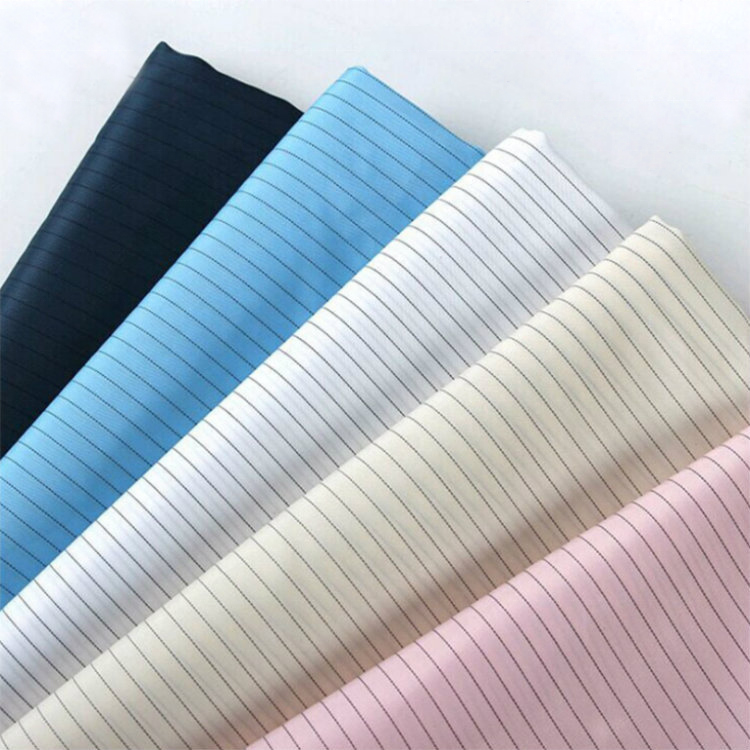
ESD fabric is a textile engineered to help control electrostatic charge. It is commonly used to manufacture ESD coats, coveralls, jackets, trousers, caps, gloves, and cleanroom garments.
The base textile is often polyester or a polyester-cotton blend. These fibers provide strength, washability, dimensional stability, and comfort. On their own, however, they may not offer the electrical performance required in an electrostatic protected area.
Conductive fibers are therefore added to the textile.
They may be introduced as:
Carbon-filled filaments
Carbon-coated fibers
Metal fibers
Metal-coated synthetic yarns
Conductive composite yarns
Blended conductive sewing thread
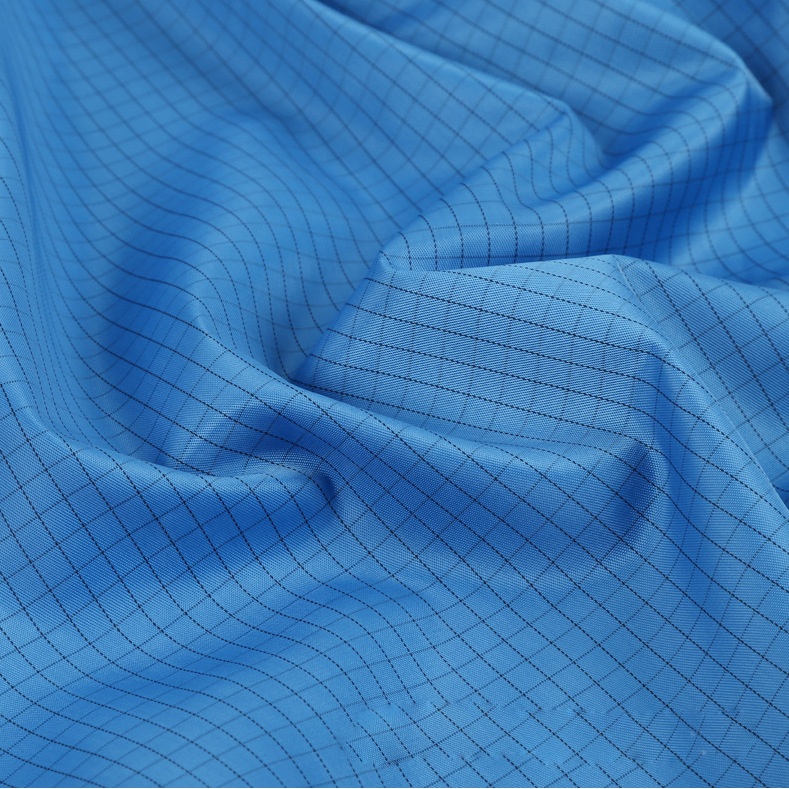
These conductive elements are distributed through the fabric in stripes, squares, or a cross-grid pattern. From a distance, they often appear as thin black lines running through a white, blue, pink, or other colored textile.
The percentage of conductive fiber may be relatively small, but its placement is important. The conductive yarn must form a sufficiently continuous network across the material.
Conductive yarn is the working part of many ESD textiles. Unlike standard textile yarn, it contains material that allows electrical charge to move through or along it.
The yarn does not need to carry large electrical currents. Its job is to provide a controlled route for small electrostatic charges.
When charge develops on the fabric, conductive yarn helps spread it over a wider area. This reduces the chance of a high local voltage building up at one point. Depending on the garment design and grounding system, the charge may then dissipate gradually or travel toward a designated ground connection.
Conductive yarn can be produced in several ways.
Conductive fibers can be blended with polyester, cotton, or other conventional textile fibers before the yarn is spun.
This approach gives the yarn a combination of electrical and mechanical properties. The conventional fibers contribute softness, flexibility, and strength, while the conductive material provides an electrical path.
LEENOL, for example, offers conductive yarn and antistatic sewing thread made from combinations of polyester, metal fiber, cotton, and conductive fiber for applications such as conductive textiles, wrist straps, gloves, brushes, and other ESD products.
Another method uses continuous conductive filaments. A carbon-based or metal-coated filament may be combined with standard polyester filaments to create a yarn that can be woven directly into the fabric.
Because the conductive component runs continuously along the yarn, it can provide a more stable path than a discontinuous coating applied only to the finished surface.
Fine metal fibers or conductive filaments may also be wrapped around a conventional yarn core. This design allows manufacturers to balance conductivity with flexibility and processability.
Academic reviews of conductive yarns note that their electrical performance is strongly influenced by the material used, the arrangement of conductive elements, and the geometry of the yarn structure.
In other words, two yarns described as “conductive” may behave very differently after weaving, sewing, stretching, and repeated washing.
Carbon fiber is widely used in ESD fabric because it offers useful conductivity without making the textile excessively heavy or rigid.
In this context, “carbon fiber” does not necessarily refer to the thick structural carbon-fiber sheets used in aircraft or automotive parts. ESD textiles generally use much finer carbon-containing filaments or composite conductive fibers designed for textile processing.
Carbon-based conductive material has several practical advantages:
It can be produced in very fine fibers.
It can be combined with polyester or nylon.
It is lighter than many metallic alternatives.
It does not rust like untreated metal.
It can tolerate repeated bending.
It is suitable for grid and stripe constructions.
Its dark color makes conductive lines easy to identify.
Carbon-containing fibers allow charge to move because the conductive carbon forms an interconnected path through the filament. Once enough conductive material is connected, electrons can travel through that network rather than remaining trapped on the insulating textile surface.
This principle is sometimes described as a conductive network or percolation path. If the conductive particles are too isolated, the yarn remains highly resistive. When they are sufficiently connected, electrical resistance falls and the yarn becomes useful for static control.
One of the most recognizable forms of ESD fabric is polyester cloth with black conductive lines woven into a grid.
The grid may use narrow spacing, such as 5 mm, or a wider arrangement depending on the intended application. Some fabrics use only vertical or horizontal stripes, while others use a complete square pattern.
The visible design is not merely decorative. It determines how frequently the conductive yarn intersects across the fabric.
At each intersection, the conductive lines form part of a larger network. If charge appears between two lines, it does not have to travel far before reaching a conductive path. A closer grid generally creates more frequent conductive routes, although grid spacing alone does not determine total performance.
The result also depends on:
The conductivity of the yarn
The percentage of conductive fiber
Yarn continuity
Weave density
Fabric thickness
Surface treatments
Humidity
Garment construction
Washing and wear
A typical ESD fabric may combine a mostly polyester base with a small proportion of conductive fiber. LEENOL lists carbon-fiber grid and stripe fabrics for ESD garments and cleanroom workwear, including washable polyester-cotton constructions with integrated conductive yarn.
These terms are often used interchangeably in product descriptions, but they do not mean exactly the same thing.
A conductive fabric allows electrical charge to move relatively easily. It usually has lower electrical resistance than dissipative material.
In ESD applications, extremely low resistance is not always the goal. Charge should be controlled rather than released in a sudden, uncontrolled event.
Static-dissipative material allows charge to move more slowly and in a controlled way. This can reduce the likelihood of a rapid discharge.
Many ESD garments are designed to operate in a conductive or dissipative range depending on their construction and intended grounding method.
“Anti-static” is a broader term. It may describe material that reduces charge generation, encourages dissipation, or has been treated with an anti-static chemical finish.
A fabric marketed as anti-static does not automatically provide the same permanent conductive network as ESD fabric containing woven carbon yarn.
Some surface treatments work by attracting moisture from the air. They can be effective under suitable conditions, but their performance may change with humidity, contamination, or washing.
For critical electronics applications, buyers should look beyond the product name and check the fabric construction, resistance data, testing method, and intended use.
Imagine a worker wearing an ordinary polyester coat in an assembly area.
As the sleeves rub against an inner shirt, charge may develop on both fabrics. Because standard polyester is relatively insulating, that charge can remain localized. When the worker approaches a grounded object or sensitive component, the electrical potential may discharge suddenly.
With ESD clothing, conductive yarn changes the behavior of the fabric.
The charge is distributed across the conductive grid rather than being held at one point. If the garment is part of a properly designed grounding system, the charge can move through the garment toward ground.
Even when the garment is not directly grounded, a continuous conductive structure can help reduce localized charge and suppress electrostatic fields around the wearer.
This is why ESD fabric should be evaluated as part of a garment, not only as a flat textile sample. The sleeves, front panels, back panel, cuffs, seams, snaps, and grounding points must work together.
IEC 61340-4-9 provides test methods for measuring the electrical resistance of static-control garments, including garments made with conductive or dissipative components.
A garment can use suitable ESD fabric and still perform poorly if it is assembled incorrectly.
Each garment panel may contain conductive yarn, but charge must also move across the seams connecting those panels. Standard insulating thread or unsuitable seam construction may interrupt the electrical path.
Manufacturers can address this by using conductive sewing thread, overlapping conductive areas correctly, and designing seams that maintain panel-to-panel continuity.
This is especially important around:
Sleeves
Cuffs
Front closures
Pockets
Grounding snaps
Elastic sections
Detachable components
A resistance reading taken from the center of the back panel may look acceptable even when the sleeve has become electrically isolated. Finished-garment testing is therefore more meaningful than relying only on the fabric supplier’s original resistance figure.
The answer depends on the garment design and the ESD control program.
Some ESD coats are intended mainly to contain charges generated by the wearer’s clothing. Others are designed as groundable garments and include conductive cuffs or connection points linked to a grounding system.
A groundable garment may work with a wrist strap, grounding cord, monitor, or another approved personnel-grounding arrangement.
The garment should never be treated as an isolated solution. ESD protection normally involves several coordinated measures, such as:
Personnel grounding
ESD flooring
ESD footwear
Grounded workbenches
Conductive or dissipative packaging
Ionization
Humidity management
Suitable tools and storage equipment
The effectiveness of ESD fabric depends partly on how it interacts with these other controls.
Conductive yarn and carbon fiber provide the basic electrical function, but real-world performance can still change.
Moisture generally makes many textile surfaces more conductive. In very dry conditions, resistance may increase and ordinary fabrics may generate more static charge.
A well-designed conductive grid reduces dependence on humidity, but environmental conditions still influence test results.
Oil, dust, adhesives, flux, cosmetic products, and detergent residue can alter the textile surface. Some contaminants increase resistance, while others create irregular conductive paths.
Correct washing removes contamination. Poor washing may damage conductive yarn, leave chemical residue, or weaken seams. Bleach, fabric softener, strong alkaline detergent, and excessive drying temperatures are common concerns.
Elbows, cuffs, knees, pockets, and closures experience repeated friction. Conductive fibers can eventually break, particularly in heavily worn areas.
An oversized, open, or poorly fastened garment may not fully cover the worker’s ordinary clothing. An excessively tight garment may place more stress on seams and conductive yarns.
ESD fabric is commonly evaluated through electrical-resistance measurements. Depending on the material and garment, testing may include:
Surface resistance
Point-to-point resistance
Panel-to-panel resistance
Sleeve-to-sleeve resistance
Resistance to a groundable point
Complete system resistance
Testing conditions matter. Humidity, conditioning time, electrode placement, test voltage, and sample cleanliness can all affect the result.
For meaningful quality control, manufacturers and end users should follow a repeatable method instead of comparing measurements taken under unrelated conditions.
It is also useful to test garments after repeated laundering. A new fabric may perform well initially, but industrial users need to know whether the conductive yarn remains continuous after normal use, washing, drying, and abrasion.
The best fabric depends on where and how the garment will be used.
A cleanroom may require low-lint polyester ESD fabric with a close conductive grid. A general electronics assembly area may use a polyester-cotton fabric for improved comfort. A warmer environment may require a lighter textile, while a heavy-duty production area may prioritize abrasion resistance.
Before selecting a fabric, buyers should consider:
Fabric composition
Conductive-fiber type
Grid or stripe spacing
Surface resistance
Fabric weight
Breathability
Dust-generation level
Washability
Color options
Cleanroom requirements
Garment design
Grounding method
It is worth requesting data for the complete fabric specification rather than assuming that every black-grid material offers the same performance.
ESD fabric works because conductive yarn changes the electrical behavior of an otherwise insulating textile. Carbon fiber or another conductive material forms a network through the fabric, helping static charge spread, dissipate, or move toward ground instead of remaining concentrated on the garment.
The visible grid is only one part of the system. Yarn construction, carbon content, weave pattern, seams, conductive thread, garment design, grounding, washing, and testing all contribute to actual performance.
LEENOL supplies ESD fabric, conductive yarn, antistatic sewing thread, ESD clothing, cleanroom garments, grounding products, workbenches, storage systems, and packaging materials for electronics factories, laboratories, cleanrooms, and other static-sensitive environments. With different fabric compositions, conductive-grid patterns, colors, weights, and customization options available, LEENOL can support customers in selecting ESD fabric that matches their garment design, production environment, and static-control requirements.