English
Views: 0 Author: Site Editor Publish Time: 2026-07-07 Origin: Site


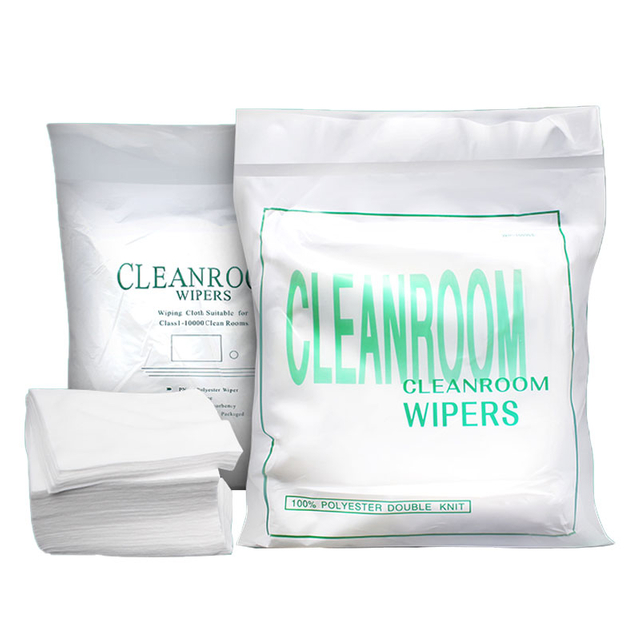
A Cleanroom Wiper is easy to overlook because it is a small, disposable item. In most facilities, it arrives in sealed bags, is used for a few minutes, and is then discarded. But its effect on the cleaning process can be much greater than its appearance suggests.
Problems usually appear during actual use. A wiper may leave loose fibers around PCB components, smear oil instead of lifting it, absorb more isopropyl alcohol than expected, or tear when used on a rough fixture. In semiconductor assembly, the concern is not limited to visible lint. Residue, particles, or extractables left on a critical surface may affect later process steps even when the part looks clean.
For that reason, selecting a Cleanroom Wiper should start with the application. Buyers need to consider the surface material, the type of contamination, the cleaning liquid, and the level of risk if residue remains after wiping.
An electronics production line may need a low-lint polyester wiper for PCB cleaning and a more absorbent product for equipment maintenance. A laboratory may use one material for benches and another for optical instruments. Semiconductor assembly usually requires tighter control over particles, fibers, edge treatment, and packaging.
In practice, many facilities do not rely on one wiper for every job. They use several grades and assign each one to a defined cleaning task.

Wipers are often managed as ordinary consumables. Purchasing teams compare the price per pack, production staff use what is available, and repeat orders are placed without much review.
This approach works until the product starts affecting the process.
A wipe that tears easily may increase consumption. A material that holds too much solvent may raise cleaning costs. Visible lint can lead to repeat cleaning, while less obvious residue may cause inspection failures or process variation. None of these problems is dramatic on its own, but across hundreds of cleaning tasks, the waste becomes noticeable.
The lowest-priced wiper is therefore not always the lowest-cost option. At the same time, using a high-specification product for routine bench cleaning may also be unnecessary. The better approach is to match the wiper grade to the actual contamination risk.
Product descriptions often use terms such as lint-free, high absorbency, low particle generation, or solvent resistant. These terms are useful, but they do not tell the whole story.
Two wipes can both be described as polyester and still perform differently. One may be heavier, more tightly knitted, or treated at the edges. Another may be softer but less resistant to abrasion. The differences may only appear after the wipe is wet and used under pressure.
Before selecting a product, look at the process in detail.
The surface is the first filter.
A stainless steel table can tolerate more pressure than an optical lens. A rough machine housing may pull fibers from a lightweight wipe. A polished component may show scratches or streaks that would not matter on an equipment cover.
Some surfaces are also harder to clean than they appear.
PCB assemblies contain leads, corners, solder joints, and small gaps that can catch loose fibers. Laboratory instruments often include smooth panels that show streaking easily. Semiconductor tools may have narrow access points where operators need a wipe that folds well and stays stable.
The material must suit both the surface and the shape of the area being cleaned.
Not all contamination behaves in the same way.
Loose dust is different from grease. Fingerprints are different from solder paste. A small water spill is different from a thin film of process oil.
Dry particles need to be captured. If the wipe simply pushes them across the surface, the surface may look clean but the contamination has only moved.
Grease and oil require good contact and enough strength to keep wiping after the material becomes wet. Sticky residues may need several passes and more pressure. Fine particles on optical or electronic surfaces usually require a softer wiping face.
This sounds obvious, but it is often skipped during purchasing.
The buyer sees “cleanroom wiper” and assumes the product can handle every cleanroom task. In practice, that is rarely true.
Dry wiping is useful for light dust and loose particles. It is also quick, which is why operators often prefer it.
However, dry wiping can increase friction and may move contamination rather than remove it.
Wet wiping usually improves cleaning, especially when the correct solvent is used. The wiper must then remain strong, maintain its structure, and release the liquid in a controlled way.
This is where absorbency needs to be understood properly.
A wipe that absorbs a large amount of liquid is not automatically better. For spill control, high absorbency is helpful. For precision cleaning with isopropyl alcohol, too much absorbency may simply mean that the wipe takes more solvent from the bottle.
Operators notice this quickly. Purchasing teams often notice it only after solvent use increases.
Low particle and fiber release is one of the main reasons for using a Cleanroom Wiper.
Still, no wipe should be treated as producing absolutely no lint under every possible condition. The phrase “lint-free” is widely used, but it is better understood as a relative description.
The actual result depends on several things:
The fiber material
The fabric construction
The cutting method
The edge treatment
The surface being wiped
The amount of pressure used
Whether the wipe is dry or wet
The solvent involved
A wipe may perform well on a smooth glass plate and shed more fibers on an unfinished metal edge.
For routine cleaning, visual checks and a production trial may be enough. For sensitive semiconductor or precision electronics work, particle and extractable data may need to be reviewed.
The amount of testing should match the risk. There is no need to overcomplicate a low-risk bench-cleaning task, but there is also no reason to guess when direct product contact is involved.
Absorbency is usually presented as a single advantage. In use, it has several parts.
A wiper may absorb quickly but hold only a moderate amount of liquid. Another may hold more liquid but absorb it more slowly. A third may retain solvent so strongly that it does not release enough during cleaning.
Think about what the operator is actually trying to do.
For a spill, fast uptake matters. For applying alcohol across a PCB surface, even liquid distribution may matter more. For cleaning oil, the wipe needs both uptake and enough internal structure to keep the contamination away from the active wiping face.
It is worth testing this with the real liquid. Water-only testing can be misleading when the production line uses alcohol, oil, or a mixed cleaning agent.
Some wipes feel strong when dry and become weak after a few seconds of contact with liquid.
That may be acceptable for a light, single-pass cleaning task. It is a problem when the operator must scrub a fixture or wipe around a rough edge.
Low wet strength leads to tearing, extra consumption, and small fragments left on the surface. It also changes operator behavior. People begin folding several wipes together, which increases cost without anyone formally recording it.
A suitable Cleanroom Wiper should remain stable for the full task, not just during the first wipe.
Softness matters on coated, polished, or highly visible surfaces.
Microfiber is often selected for these applications because its fine structure creates good surface contact. It can be useful for removing fingerprints, fine dust, and light films.
However, microfiber is not automatically the best choice for every cleanroom.
Some applications need stronger chemical resistance or lower particle generation under abrasion. Others need a more economical wiper for routine work. The material name is only the starting point.
The safest approach is to test the wipe on the actual part, especially when the surface is coated or easily scratched.
A Cleanroom Wiper must tolerate the liquid used in the process.
Common examples include:
Isopropyl alcohol
Ethanol
Deionized water
Cleaning agents
Degreasers
Process-specific solvents
A wiper may look unchanged after brief contact but still release residue or lose strength during repeated use.
The solvent concentration matters too. A product tested with diluted alcohol may not behave in the same way with a higher concentration.
For routine applications, a practical compatibility trial is often enough. For critical processes, supplier data should be reviewed where available.
The edge is easy to ignore because buyers usually focus on the center of the fabric.
In practice, edges can be a major source of loose fibers.
Basic cut edges may be suitable for general cleaning. More controlled edge treatments can reduce fraying and improve consistency during folding and wiping.
That does not mean every facility needs the most expensive edge option.
For wiping floors, benches, or machine exteriors, a basic edge may be acceptable. For wiping critical components or precision equipment, edge quality deserves more attention.
Wiper size affects cost, usability, and contamination control.
Smaller wipes are convenient for components and localized cleaning. Larger wipes are better for benches, equipment panels, and spill response. Common sizes include 4 × 4, 6 × 6, 9 × 9, and 12 × 12 inches.
The best size is not always the smallest one that can complete the task.
Operators often fold larger wipes to create several clean faces. This can reduce the need to reach into the package repeatedly. On the other hand, an oversized wipe may become bulky and difficult to control around small parts.
A short production trial will usually make the right size obvious.
Polyester wipers are widely used in electronics and controlled manufacturing.
Knitted polyester usually provides good strength, relatively low lint, and compatibility with common cleaning solvents. It is often selected for PCB cleaning, equipment maintenance, precision parts, sensors, and other tasks where fiber control matters.
Polyester is also durable when wet, which makes it useful for repeated wiping.
Still, there can be significant variation between polyester products. Fabric weight, knit density, laundering, cutting, and edge treatment all influence performance.
A product should not be approved simply because “polyester” appears on the specification sheet.
Microfiber wipers are made with very fine fibers that create greater contact with the surface.
They are often used for:
Optical components
Display panels
Sensors
Polished surfaces
Fine dust
Fingerprints
Light oil films
They usually feel softer and may clean smooth surfaces with less visible streaking.
Some microfiber products are made from polyester and nylon blends. Others use different structures. Buyers should confirm the exact composition rather than treating all microfiber products as identical.
Microfiber can be highly effective, but it should still be evaluated for solvent resistance, extractables, and edge performance.
Polyester-cellulose wipes combine synthetic strength with cellulose absorbency.
They are common in laboratories, general cleanroom maintenance, bench cleaning, equipment wiping, and spill handling. They are often more economical than high-specification knitted polyester wipes.
For many routine tasks, this type of wiper offers a good balance.
The trade-off is that it may not be suitable for the most particle-sensitive applications. Direct contact with critical semiconductor components, for example, may require tighter control.
This is a good example of why the most absorbent option is not always the right option.
Cleanroom paper and nonwoven materials are useful for general wiping, liquid handling, equipment cleaning, printing processes, and maintenance work.
They are usually convenient and cost-effective.
However, the term “cleanroom paper” covers a broad range of products. Particle release, wet strength, and solvent compatibility can vary. The same selection rules still apply.
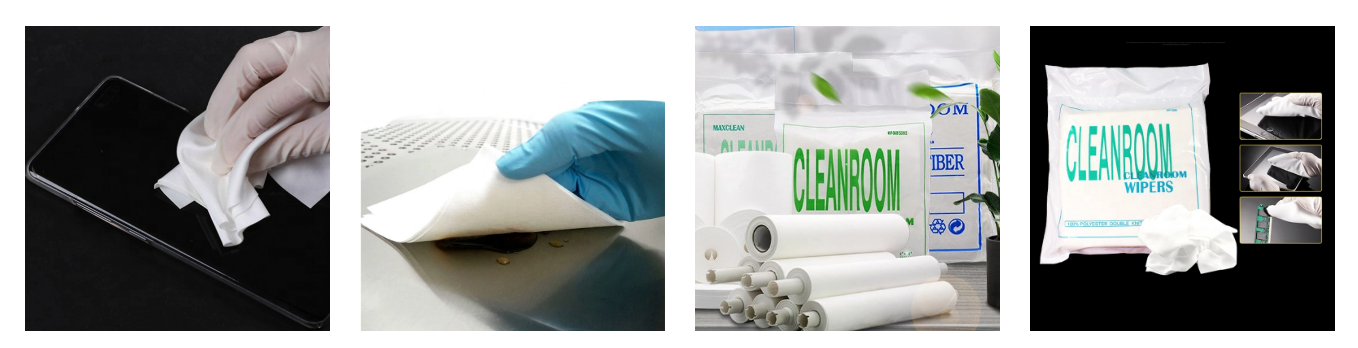
Electronics factories usually need more than one wiper.
PCB surfaces can hold flux residue, dust, oil, and fingerprints. A suitable wiper should remove contamination without leaving fibers around solder joints or components.
Polyester and microfiber options are often considered here.
The wiper should also work with the cleaning solvent. If alcohol is used, check whether the material absorbs too much or dries too quickly during wiping.
A common mistake is using a large general-purpose wipe for small PCB work. It can be awkward and wasteful. A smaller wipe is often easier to control.
Stencil cleaning is more demanding than routine surface wiping.
Solder paste and adhesive are difficult to remove, and stencil apertures must remain clean. Loose fibers can affect printing quality.
For automatic systems, reel or roll compatibility is critical. Width, core size, length, material thickness, and liquid behavior all need to match the machine.
For manual cleaning, strength and low lint are usually the main concerns.
This is not an area where a “close enough” product is a good idea.
Displays, camera modules, sensors, and optical parts show streaking and scratches easily.
A soft microfiber or fine polyester wiper may work well. The cleaning method is just as important as the material.
Operators should use a fresh surface, avoid excessive pressure, and keep gloves clean. Reusing the same section of a wipe can simply move contamination back onto the part.
Laboratories often have a wider range of cleaning tasks than expected.
For routine benches, trays, and equipment exteriors, a polyester-cellulose or suitable nonwoven wiper is often practical.
These tasks usually need absorbency, wet strength, and reasonable cost.
There is little value in using a high-grade precision wipe for every bench. It increases cost without improving the outcome.
Balances, display screens, lenses, polished parts, and instrument panels require more care.
A rough general-purpose wipe may leave fibers or streaks. Microfiber or fine polyester may produce a cleaner finish.
Again, testing matters. Some coatings are more sensitive than they appear.
Spill response is mostly about speed, absorbency, size, and safe disposal.
The liquid type matters. Water, oil, chemical agents, and biological materials should not be treated in the same way.
The wiper must fit the laboratory’s safety procedure. It does not replace gloves, chemical controls, or proper waste handling.
Semiconductor assembly requires tighter contamination control.
A wipe can look clean and still release particles, ions, or organic residue. That is why visual inspection alone may not be enough.
Depending on the process, buyers may need information about:
Particle generation
Fiber release
Ionic contamination
Nonvolatile residue
Absorbency
Chemical compatibility
Edge treatment
Packaging conditions
Not every process needs every test.
The requirement should come from the contamination risk, not from a desire to collect as many certificates as possible.
One of the most practical approaches is to divide wiping tasks into zones.
A high-grade wiper may be reserved for direct product contact, tooling, or precision surfaces. A more economical wipe can be used for benches, carts, machine covers, or routine maintenance.
This reduces cost without lowering process control.
It also helps avoid the opposite problem: using a general-purpose wipe in an area where the contamination risk is much higher.
Even a good Cleanroom Wiper can be used badly.
Operators should avoid touching the active surface, returning unused pieces to an open pack, or wiping repeatedly with a contaminated face.
Folding methods can be standardized. Wiping in one direction is often better than moving back and forth over the same area.
These details may seem minor, but they are usually where day-to-day consistency is won or lost.
Purchasing decisions are often made on cost per bag or cost per sheet.
A better comparison looks at the full task.
Consider:
How many wipes are used per cleaning cycle?
How much solvent is consumed?
Does the wipe tear?
Does the operator need to wipe the surface twice?
Are fibers found during inspection?
Is the package easy to use without contaminating the remaining wipes?
Does the product remain consistent from batch to batch?
A wipe that costs slightly more may reduce total consumption.
The opposite can also be true. A premium product may add no value in a low-risk application.
Good purchasing is not about always choosing the higher specification. It is about knowing where the higher specification is justified.
Samples should be tested in the real process.
Not on a clean office desk. Not only with water. Not by one person for two minutes.
Use the actual surface, solvent, contaminant, and wiping method.
Ask operators to check:
Does the wipe drag?
Does it tear?
Does it leave visible fibers?
Does it absorb too much solvent?
Is it easy to fold?
Does it feel too stiff or too thin?
Does it clean the surface in one pass?
Operator feedback is valuable because small usability problems quickly become large consumption problems.
For critical semiconductor or electronics work, the trial should also include the normal inspection or contamination test.
A short line trial usually tells you more than a long product description.
This simplifies purchasing but often creates either waste or risk.
A facility may need one wipe for critical cleaning, one for general equipment, and another for spills.
That is normal.
Lint-free does not mean zero fiber under all conditions.
Ask for data where the risk justifies it. Test the product under real wiping pressure.
Some wipers use more alcohol than expected.
The difference may look small per task but become significant across a large production line.
Cleanroom class is important, but it does not describe the entire wiping process.
Surface sensitivity, chemical compatibility, edge quality, and contamination type may be equally important.
Specifications do not tell you whether a wipe is awkward to fold or tears around a fixture.
Operators will tell you that within a day.
The selection process does not need to be complicated.
First, list the main cleaning tasks in the facility.
Then separate them by contamination risk. Direct product contact should not be grouped with floor or machine-cover cleaning.
Next, identify the surface, contaminant, and liquid used for each task.
After that, choose two or three candidate materials. Polyester may suit precision work. Microfiber may suit smooth and sensitive surfaces. Polyester-cellulose may suit routine cleaning and spills.
Review the technical information that is relevant to the application.
Finally, test the products in the real process and document the approved use.
This last step is important. Without clear instructions, operators may substitute a visually similar wipe that behaves very differently.
There is no single best product for all electronics work. Polyester and microfiber wipers are commonly used for PCBs, sensors, displays, and precision parts. The final choice should depend on the contaminant, solvent, surface sensitivity, and acceptable particle level.
No. Microfiber is often effective on smooth and delicate surfaces, especially for fingerprints and fine particles. Polyester may provide better strength, chemical resistance, or particle control for other tasks. The better option depends on the process.
It should not be assumed. A wiper may work well with isopropyl alcohol but perform differently with another chemical. Compatibility should be checked using the actual solvent concentration and contact time.
Not necessarily. Cleanroom-compatible, low-lint, and sterile are different product characteristics. A wiper should only be treated as sterile when it is supplied and documented as a sterile product.
Use the sample in the real process. Test the actual surface, contaminant, solvent, and wiping method. Check for fibers, tearing, streaking, solvent use, operator comfort, and cleaning efficiency. For critical applications, include the facility’s normal contamination or inspection test.
Choosing a Cleanroom Wiper is not about finding the most expensive or most technical product. It is about matching the wiper to the job. Electronics plants may focus on lint and solvent resistance. Laboratories may need a balance of absorbency, strength, and surface protection. Semiconductor assembly requires closer control of particles, extractables, packaging, and handling. LEENOL supplies polyester, microfiber, polyester-cellulose, cleanroom paper, industrial wiping, and stencil-cleaning products for different controlled environments. Buyers can use the LEENOL range as a practical starting point, then narrow the choice through samples, process trials, and real operator feedback.